
About the Csángó people
For over 700 years, most Csángó (pronounced SANG-go, rhymes with Tango) people have occupied land controlled by Romanians, in the region of Moldavia. A few, however, lived in the the Carpathian Mountain passes between Moldavia and Transylvania, and in the “Seven Villages”, which were in Hungary until the end of WWI. For centuries, the self-identity of the Csángós was based on the Roman Catholic religion and the Hungarian language spoken in the family. It is generally accepted by serious scholars (Hungarian but also Romanian) that the Csángós have a Hungarian origin, and that they arrived in Moldavia from the west.
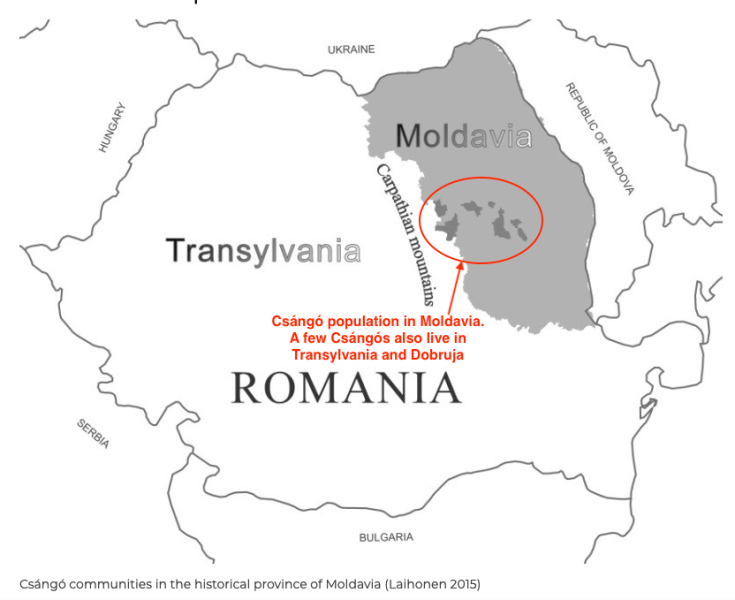
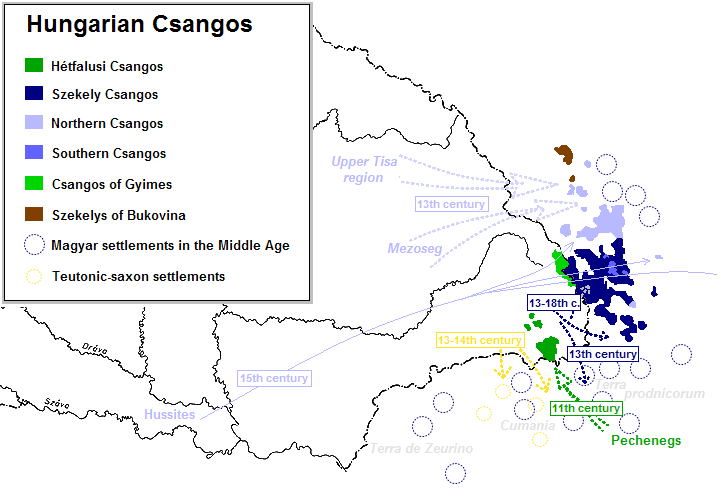
The Csángós migrated into Moldavia in many waves, at least from the 13th century till the 18th century, maybe earlier. The Csángós speak a Hungarian dialect known as Csángó. The Council of Europe claimed the number of speakers of this dialect to be 60,000 to 70,000 people in 2001. Their traditional language is currently used by only a minority of the Csángó population group. According to the most recent research executed between 2008 and 2010 by Vilmos Tánczos, famous Hungarian folklorist, there has been a sharp decline in the total number of Csángó-speaking people in Eastern Romania. Tánczos set their number to roughly 43,000 people. Moreover, he found out that the most archaic version of Csángó language, the Northern Csángó was known and regularly used by only some 4,000 people, exclusively the older generation above the age of 50. It can be said, therefore, that the Csángó Hungarian dialect is in high risk of extinction. In fact, when applying the UNESCO Framework to measure language vitality, this dialect fits the category of “Severely Endangered”.
They speak the most archaic dialect of Hungarian, and their music is the most archaic Hungarian music, The Csángó did not take part in the language reforms of the Age of Enlightenment, or the bourgeois transformation that created the modern consciousness of nationhood (cf. Halász 1992, Kósa 1998). They did not have a noble stratum or intelligentsia (cf. Kósa 1981) that could have fashioned their consciousness as Hungarians (Halász 1992: 11). They were “saved” (Kósa 1998: 339) from “assimilation” with the Romanians by virtue of their Roman Catholic religion, which distinguished them from the majority Greek Orthodox society. Some Csángó also live in Transylvania (around the Ghimeș-Palanca Pass and in the so-called Seven Csángó Villages) and in the village of Oituz in Northern Dobruja.
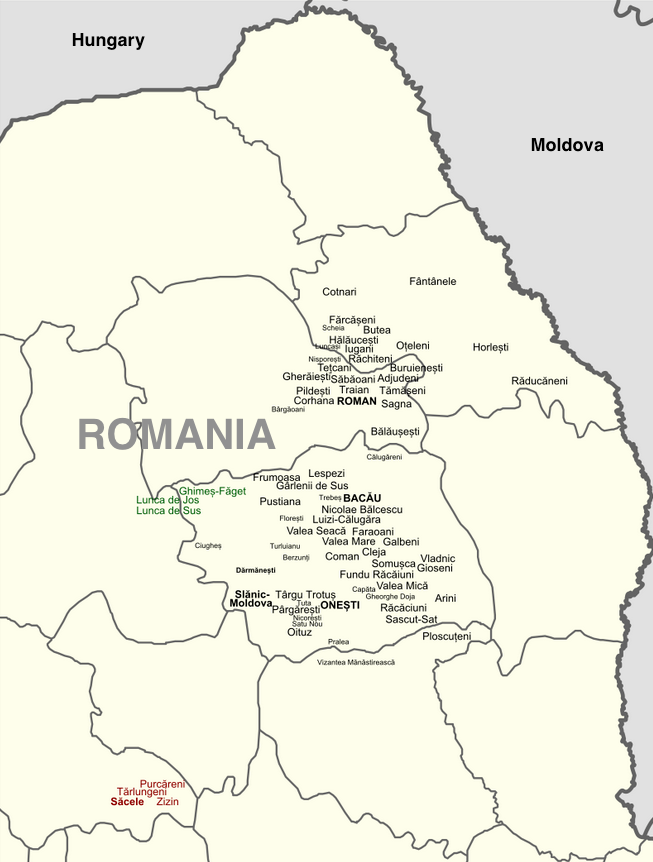
Black: Csángós of Western Moldavia, (Moldvai Csángó)
Green: Csángós around the Ghimeș-Palanca Pass, (Gyimesi Csángó)
Red: Csángós of the Seven Villages. The Csángós of Northern Dobruja are not shown in this map.
The Csángós had historically been a rural and agricultural people, raising stock like sheep and cows and farmed crops such as corn, potatoes, and hemp. Before the Communist era and the collectivization efforts, the Csángós were structured in a traditional society until the introduction of civil code. Village elders were well respected and could be pointed out by their traditionally long hair and beards. Notably, some Csángós also participated in the 1907 Romanian Peasants’ Revolt and fought on behalf of Romania in both world wars.
Source of texts and maps above: Wikipedia.
Magyar Museum article
Source for text below: https://magyarmuseum.org/csangos-moldava/csangos-the-forgotten-hungarians/
In Csángó villages the ‘Spinning Room’ was the only place of recreation for the youth. Friendships were born here, and dating – which led to marriage – also started here. A lot of singing was done in the ‘Spinning Room’. To this day, they especially like to sing the long, beautiful ballads about the difficulties of love and life.
Their folk dances incorporate many elements of Southeast Europe and even some from the West can be noticed. These influences were of importance in the development of the instrumental dance music. They also have couple dances like those in Transylvania and even the csárdás is known, but most common are the archaic line- and circle dances.
In the first half of this century a Moldavian folk dance band used the following instruments: recorders (the shorter sültü with 6 and the longer kaval with 5 holes), lute (koboz) and drum. Since the sixties they used the violin, drum, cimbalom and lute. Most recently a folk dance band plays the violin, drum, harmonica and saxophone.
Csángó dancing in modern (2014) Budapest
An example of Csángó dancing in modern (2014) Budapest found here: https://lostandfoundinbudapest.wordpress.com/2014/12/10/when-a-dance-class-became-something-else/
It was rather daunting to be in a room full of older people, who looked like they knew exactly what they were in for. The Csángó Dance House is an amazing venue bustling with different dance classes throughout the week. We made an attempt at this form of folk dancing and I think we can now proudly say we wouldn’t embarrass ourselves at a Csángó Dance party. Csángó people are living mostly in Romania and, like every ethnographic group, they have their own identity signs, like a language –which came from Hungarian – mores, and their own folk dance.
Csángó music was brought into Budapest 25 years ago by Kerényi Róbert and his friends, a group of passionate musicians. It was not the first time Csángó music was introduced to Budapest, but somehow only they had succeeded.
Gradually they found that more people were attending these Csángó dance classes and it became a huge party, the dancing was never confined to the dance classes. During the dance parties a music band plays live on the dance floor, adding to the exciting atmosphere. There are 4 bands that play at Csángó Dance House and they play a variety of folk music, from Moldavia to Gyimes. These are both Csángó regions, but they differ greatly in their dance cultures.
During the dance class we found ourselves fumbling around with two left feet, struggling to be in time with the music. We stood in a huge circle, hands held, shuffling our feet and trying our best to be in sync. This form of dancing, which involves dancing in a circle and then dancing with our partners, requires team work and that every dancer knew exactly which step was coming next, just so that the dance would continue seamlessly. We tried our best not to burden our partners; dancers who looked like our Dads, or even our Granddads!
We noticed that there were people with different levels of experience in Csángó dance in our class and we asked our dance teacher how they manage to ensure that everyone leaves learning something new. She mentioned that it is at time difficult to satisfy everyone, but we know we definitely left the class learning something new.
According to our dance teacher, the huge dance party after the dance class is usually an extremely crowded affair. On average, there would be close to 100 people, varying on the popularity of the band playing. She also added that there can be up to 250 people at the party if there is a bigger event like a ball. The best part is that Csángó dance house also has a dance party for children in kindergarten, even though the huge party welcomes everyone.
More information
More details can be found here: https://magyarspirit.blogspot.com/2013/10/the-csango.html and here:http://szépszerével.hu/index.php/pl/krakko-2020-pl-2
COMMENTS:
John Uhlemann wrote: “While the Csángó can be split up into linguistic and historical groups, culturally and dance-wise it is really between the Gyimesi Csángó and the Moldvai Csángó. It is too bad the latter came to be recognized, and their dances researched, after the International Folk Dance movement had already started to wane in the US. These are circle and line dances with great music, and just made for the typical recreational group. We do several here in St. Louis, and they are popular. The dances of Gyimes are more difficult, for the most part (with exceptions) they are couple dances; and the music more quirky for the casual listener. The Moldvai Csángó dances,though, are so popular in Budapest among the late-teens/early 20’s crowd that there is a special dance night set aside, with live music, that has nothing but dances from the Moldvai Csángó region. Here is a dance we do in St. Louis (done here at the Moldvai Csángó Táncház): https://www.youtube.com/watch?v=73bLg1SF2U4 . Here is another, with the band I saw myself in this venue a few years ago (Steve Kotansky teaches this): https://www.youtube.com/watch?v=PZbOfUzSlI0 .
 Folkdance Footnotes