
Few people post YouTubes of their children playing, though many people post YouTubes of their children in school performances, and teachers post YouTubes of their classroom achievements. A dance performed in public to display one’s own cultural heritage is by my definition a 1st Generation dance. If it is also performed because you enjoy it whether or not anybody is watching, I consider that a Living Dance. Posted YouTubes show adults consider a dance important enough that they teach it to their children as part of their cultural heritage. Do the children themselves dance it for fun if they aren’t required to by adults? Do they teach it to each other at home or on the playground? I have yet to see a YouTube showing a Living Children’s dance, but I’m searching!
Syvspring background
https://www.pbslearningmedia.org/resource/2f45c2db-bd3e-44cc-b255-7f1c0e0c0436/seven-jumps/
“Seven Jumps”or “Syvspring” in Danish, is a dance from Denmark that is still taught today. Reportedly, this was also a song that mocked the “topsy-turvy” career of a Danish politician. . While one cannot be sure of the dance’s exact origins or what the movements mean, it is fun to speculate the different contexts in which it existed. Some believe that it was about our above-mentioned Danish politician, while others think that it could have been part of a pagan religious ritual to help the corn crop grow taller. The higher dancers jumped, the better the crop would grow! Source: https://halesharmonies.com/2021/02/23/seven-jumps-syvspring/
An ‘original’ Danish version, including Danish lyrics and a rough translation, can be read about here: http://walfamily.net/Handmaidens/Handmaidens_of_the_Shepherd/Blog/Entries/2010/10/1_Folk_Dance__Syvspring.html
Syvspring/Seven Jumps music
Syvspring/Seven Jumps demonstrations
There are MANY other variations……
Another dance with a similar name is in Holland, called “De Zevensprong.” It has very similar dance motions to its Danish counterpart.
De Zevensprong – the Seven’s Jump.
Radboud Koop has written an extensive commentary on my original article, which was largely based on information published in 1968, and found here. Radboud’s comments (in italics) can be considered either an update or a correction to the original material.
“The Dutch name “De Zevensprong” is literally to be translated as “The Seven’s Jump” (where seven is adj. and jump sing.). Nowadays it is mostly known in The Netherlands (and Flanders) as a children’s song, e.g.,
Often sung without dance movements just as a counting exercise for young children.
The lyrics show regional, local and personal variations, but a rather generic text is:
Heb je wel gehoord van de zeven-de-zeven,    Have you ever heard of the seven-of-seven,
heb je wel gehoord van de zevensprong            have you ever heard of the seven’s jump
Ze zeggen dat ik niet dansen kan,                     They say I can’t dance,
maar ik kan dansen als een edelman                 but I can dance like a nobleman
Dat is één…                                                          That’s one…
Dat is twee… etc.                                                 That’s two… etc.
As a dance it is today also mainly known as a children dance. Since basically all traditional folk dancing in The Netherlands has long died out, the Zevensprong is not really an example of a living tradition except for the children’s game. But also the children learn it in class or workshops, not as part of informal observation or imitation.
Original article, reprinted from this 1968 source: https://www.lookandlearn.com/blog/26053/the-traditional-dutch-jumping-dance-may-come-from-a-pagan-crop-ritual/ One of Holland’s most popular traditional dances is called De Zevensprong – the Seven’s Jump. It is danced in various parts of the country, but is probably best known in Volendam, where it is performed at the Fisherfolk’s Fair, in the third week of October…. The remark about De Zevensprong being “one of Holland’s most popular traditional dances” seems to be taken from the webtext. I believe this qualification is a bit doubtful. First, Holland is not the same as The Netherlands (Holland is only the western part of the country) and De Zevensprong is known all over The Netherlands. Second, I’m not aware of any reference (from literature nor experience) of this dance being “one of the most popular” dances of our country. Also, I don’t believe the dance to be particularly known in Volendam. The Volendam reference seems to be from the book Dances of The Netherlands by the Dutch folk dance author Ms. Elise van der Ven – Ten Bensel, published under the auspices of The Royal Academy of Dancing in 1949 in the series Handbooks of European National Dances, ed. Violet Alford. The dance description in this book mentions Volendam (a small city in the northwest of the country some 20 km north of Amsterdam) as region of origin of the dance (page 36), but in the text itself (page 14) a regional/local reference is missing, The dancers form a ring and move in a clockwise direction. They hold hands and look into the centre of the ring. The music, which is provided by an accordion or a small brass band, is often so loud that it almost drowns the voices of the dancers, who sing as they begin to circle. Translated the words are:
“Have you never heard of the Seven Jumps?
Have you never heard of the Seven Jumps?
Do you really think that I can’t dance it?
I dance it like a nobleman. DA’S EEN!”
On the words Da’s een (That’s one!) the dancers jump and then stamp the right foot. Then they start their walking steps again. When they have repeated the verse, they perform two jumps, stamp the right foot and then the left. With each repeat, an extra movement is added. On the third verse they kneel on the right knee, on the fourth they go down on both knees, on the fifth they put one elbow on the ground, on the sixth both elbows, and on the last the extra movement is to fall flat, touch their foreheads on the ground then spring up and turn head over heels.
In the old days, the Seven Jumps was danced round an image of Saint John, but, like so many traditional dances, no one can be sure how it began, or what its movements mean. It is thought that, in pagan times, such jumping dances were performed as part of a religious ritual to make the corn grow tall: the higher the jumps, the better the crop!
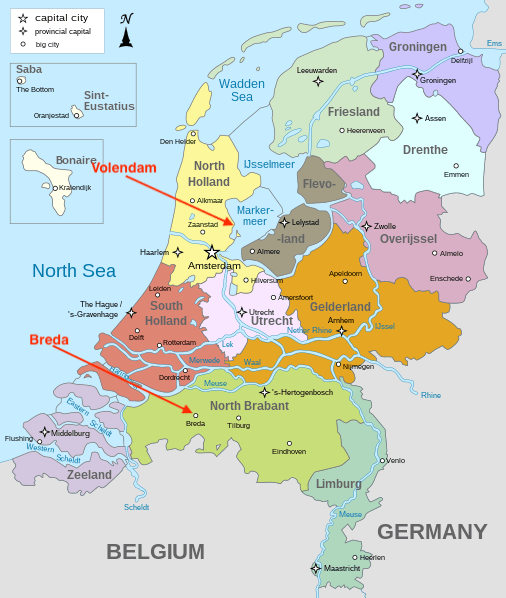
I’m not aware of the Zevensprong still being danced today in Volendam as part of the Fisherfolk’s Fair, but I also cannot exclude the possibility. Particularly, since there is a recent (2014) reference of the Zevensprong being danced (by male adults) in the city of Breda in the south of the country as part of the traditional Carnival activities (end of February, beginning of March),
COMMENTS:
John Uhlemann wrote: The most common use of the term “seven jumps” is actually not the Danish dance but one of German origin that made its way into America as the “7 Jumps Polka”, and farther east into Slovenia where the same melody was used as “Zibenšrit” or “Sibenšrit” (the “Ziben” part obviously a “Slovenianization” of the German for “7”). The melody and form of this dance is here: https://www.youtube.com/watch?v=83VxGEtGgd8 , and is a staged version of the dance taught by Dick Crum years ago. The tune and dance made it even further East into Transylvania, as done by the Hungarian population there. Sometime with the same tune, and sometime with a different one. https://www.youtube.com/watch?v=IzPXpS9_Ryk shows the usual progression: Porka és Hétlépés (= polka and 7 jumps); around 1:36 they switch to the Hétlépés. As a couple, these all go 3 steps forward and stamp, 3 steps back and stamp, 3 steps forward and stamp, 3 steps back and stamp, 4 couple pivots in LOD. This is the same as the German dance and the version done in Vermont years ago (I have not been able to find YouTubes of that).
ArjadLH wrote: The Dutch version is translated the Seven Jump.
Literally translated the Dutch lyrics are as following:
Have you heard about the seven, the seven,
have you heard about the seven jump.
They say I cannot dance,
but I can dance like a nobleman,
and that is one …. (and that is two, ….. three, and so on)
instead of lying flat on the count of seven we learn to put our head in towards our chin between the two arms.
The complete text of Radbood Koop‘s comment is reproduced here, but is also
Some additional remarks about the Dutch version “De Zevensprong”.
Indeed, the Dutch name “De Zevensprong” is literally to be translated as “The Seven’s Jump” (where seven is adj. and jump sing.). Nowadays it is mostly known in The Netherlands (and Flanders) as a children song, e.g., https://www.youtube.com/watch?v=FVwyMGzn-eM or https://www.youtube.com/watch?v=dIKJAqcYHj0 . Often sung without dance movements just as a counting exercise for young children. As a dance it is today also mainly known as a children dance, see e.g., https://www.youtube.com/watch?v=l_RGeqJ-ato or https://www.youtube.com/watch?v=ckKuDwxT-1Q where only the 7th round/pass is shown, illustrating the seven movements that are built up during the dance (1st foot, 2nd foot, 1st knee, 2nd knee, 1st elbow, 2nd elbow, (fore)head). (The latter video additionally shows the return movements, counting back from seven to one at the end of the dance, but this is not a regular part of the dance.) The lyrics show regional, local and personal variations, but a rather generic text is: Heb je wel gehoord van de zeven-de-zeven, heb je wel gehoord van de zevensprong / Ze zeggen dat ik niet dansen kan, maar ik kan dansen als een edelman / Dat is één… / Dat is twee… / etc. (translation: Have you ever heard of the seven-of-seven, have you ever heard of the seven’s jump / They say I can’t dance, but I can dance like a nobleman / That’s one… / That’s two… / etc.).
Since basically all traditional folk dancing in The Netherlands has long died out, the Zevensprong is not really an example of a living tradition except for the children’s game. But also the children learn it in class or workshops, not as part of informal observation or imitation. The remark about De Zevensprong being “one of Holland’s most popular traditional dances” seems to be taken from the webtext https://www.lookandlearn.com/blog/26053/the-traditional-dutch-jumping-dance-may-come-from-a-pagan-crop-ritual/. I believe this qualification is a bit doubtful. First, Holland is not the same as The Netherlands (Holland is only the western part of the country) and De Zevensprong is known all over The Netherlands. Second, I’m not aware of any reference (from literature nor experience) of this dance being “one of the most popular” dances of our country. Also, I don’t believe the dance to be particularly known in Volendam. The Volendam reference seems to be from the book Dances of The Netherlands by the Dutch folk dance author Ms. Elise van der Ven – Ten Bensel, published under the auspices of The Royal Academy of Dancing in 1949 in the series Handbooks of European National Dances, ed. Violet Alford. The dance description in this book mentions Volendam (a small city in the northwest of the country some 20 km north of Amsterdam) as region of origin of the dance (page 36), but in the text itself (page 14) a regional/local reference is missing, because what is written is that “Of all our dances, that which has best preserved its ritual character is the Seven Jumps. It used to be performed round the image of St. John, and when it was filmed in 1923 only men took part as tradition prescribed. […] This strange dance has its counterparts in several European countries, notably the Basque countries both Spanish and French; no doubt we can connect all these with the ritual jumping to make the corn grow tall.” The latter remark seems strange to me, because there are actually no jumps in the Zevensprong, on the contrary, with the seven consecutive movements the body is brought ever more closer to the ground. I’m not aware of the Zevensprong still being danced today in Volendam as part of the Fisherfolk’s Fair, but I also cannot exclude the possibility. Particularly, since there is a recent (2014) reference of the Zevensprong being danced (by male adults) in the city of Breda in the south of the country as part of the traditional Carnival activities (end of February, beginning of March), see https://www.youtube.com/watch?v=6LE_CopVqf0 . There are some different movements in this video, but the basic concept is clearly the same. One could view this occurrence of De Zevensprong as “living” but it seems to me to be revived or re-invented tradition.
I have some doubts about John Uhlemann’s connection of the Zevensprong to the Slovenian Zibenšrit of German origin, and the more eastern Transylvanian/Hungarian Hétlépés. While the number 7 in the name is the same, the German Siebenschritt (and all the derivations of it in Austria, Hungary, Romania (Transylvania) [Hétlépés (Hu), Şapte paşi (Ro)], Slovenia, Croatia) is to be translated as seven “steps” and not seven “jumps” (or other special ‘acrobatic’ movements as in the Zevensprong). This Siebenschritt is a couple dance and not a round dance like the Zevensprong. The seven steps of Siebenschritt refer to the step pattern of the dance, which always contain seven small steps forward/backward/sidewards over two 4/4 measures (8 cts), which is the typical pattern that defines this dance. A very common dance sequence of Siebenschritt is: meas 1-2: 7 steps fwd; meas 3-4: 7 steps bkw; meas 5: 3 steps fwd; meas 6: 3 steps bkw; meas 7-8: 7 steps fwd; repeat meas 5-8 with opp ftwk; but many rhythmical and/or directional variants exist.
 Folkdance Footnotes