
*2nd Generation dance. A dance that developed and was disseminated in a non-traditional way. 2G dances are specific – have a fixed format designed to correspond with the arrangement of a particular recording., whereas 1G dances are generic – have a shorter sequence that works with live music – where many different songs are played and arrangements vary according to the tastes of musicians and dancers. For more on the differences between 1st & 2nd G dances click here.
Cimpoi – the bagpipe
Cimpoi (cheem-POY) means ‘bagpipe’, an instrument native to Romania, similar to the Bulgarian gaida. In their comprehensive book on Romanian dance Romanian Traditional Dance, by Anca Giurchescu and Sunni Bloland (1992), the authors state “The cimpoi (bagpipe), used extensively in the past, began to disappear rapidly after World War 1. At present it is encountered only sporadically in the Danube Plain, the sub-Carpathian regions, Dobrogea, the Moldavian Plateau, and the southern part of Transylvania. These traditional instruments [fluier, caval, and cimpoi – DB] have gradually been replaced by the violin in Muntenia and Moldavia and by the clarinet in southern Transylvania.”
Wikipedia says “Its repertoire is mainly dance music, usually played accompanied by a folk orchestra or played solo to provide music for the traditional dance ensemble. The traditional repertoire of songs is very limited, consisting of about ten different melodies, each one paired with a different rhythm and dance”
For more on the cimpoi, see https://folkdancefootnotes.org/music/balkan-bagpipes/
For more on rustem, see https://folkdancefootnotes.org/dance/a-real-folk-dance-what-is-it/1st-generation-dances/rustemul-1stg-romania/
I’ve found other Cimpoi tunes in Hora, Brâul, Sirba, Geamparalele, rhythms. See https://folkdancefootnotes.org/dance/dance-information/romanian-dance-rhythms-uneven/
Then there are YouTubes containing the word Cimpoi but with playing by other instruments.
Cimpoi – the Dance
Romanian traditional folk song (“rustem“) for dance from Wallachia, Oltenia area.
I have found no YouTubes of Cimpoi being danced in Romania, on stage or otherwise. The only mention of Cimpoi in Romanian Traditional Dance (above), which lists hundreds of traditional dances, is the reference to the bagpipe. The name of the music accompanying the dance Cimpoi, Joc din cimpoi, (YouTube above) refers to a bagpipe (playing a rustem dance rhythm), not a dance named Cimpoi. I’ve found several Romanian-based YouTubes with the name Cimpoi in them – all are referring to the bagpipe.
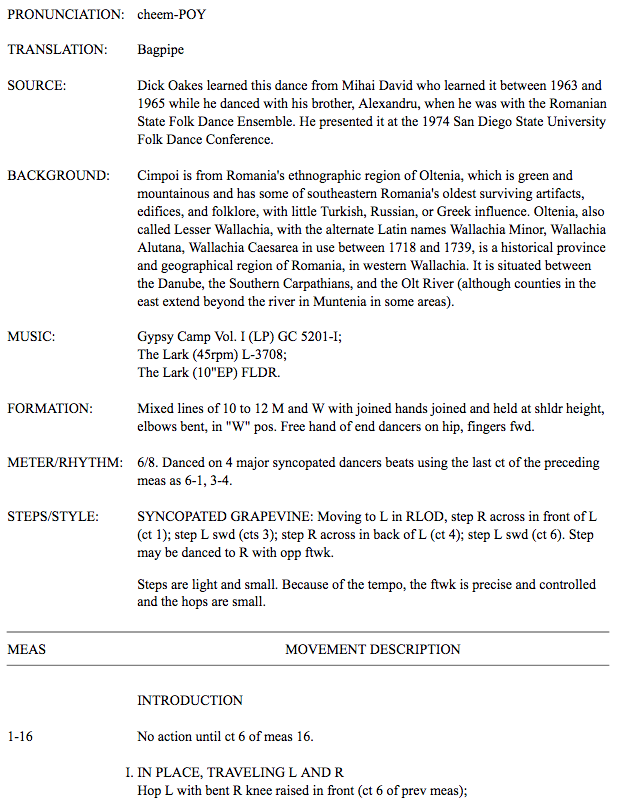
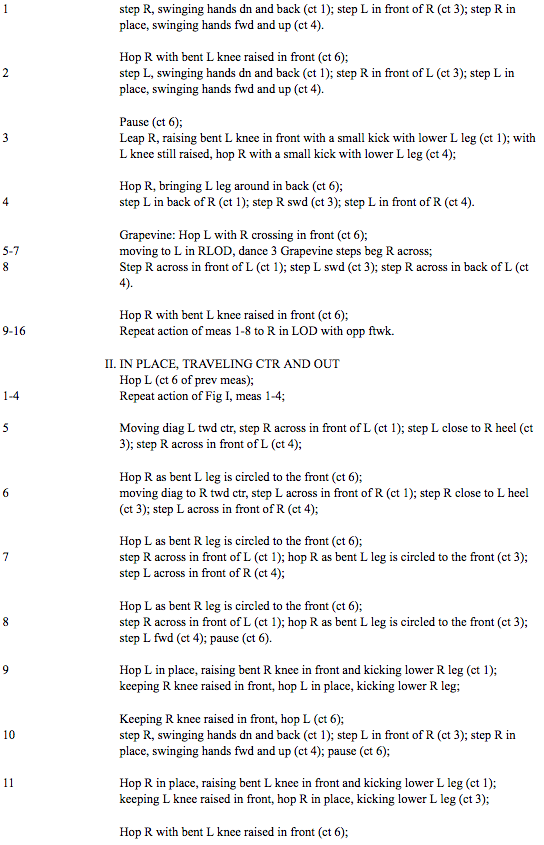
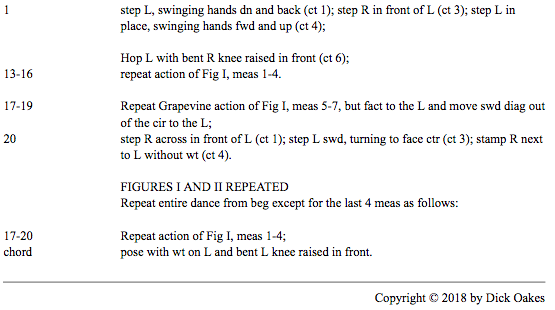
Its rhythm tells us the choreography for Cimpoi is in the rustem family of dances, but was it ever a ‘village’ dance? Mihai David, who introduced Cimpoi to North Americans, said he learned it while dancing with the Romanian State Folk Dance Ensemble, (1963-1965). Their job was to produce folk-based spectacles glorifying Romania for the theatre-going market at home and abroad. Authenticity was researched, then moulded to serve the needs of spectacle and propaganda. Often choreographies were created to correspond with stirring orchestral arrangements. That seeems to be the case here, as the footwork matches the music exactly. The exciting music and choreography are what makes Cimpoi such fun for recreational folk dancers, but only one recording is suitable.
Comment:
John Uhlemann wrote: “Mihai taught another Rustem choreography to a bagpipe tune, but since he had already used the name “rustemul,” he called the dance “Cimpoi” (meaning “bagpipe”).
“The cimpoi used by Marin Chisăr is of the south Romanian type. Chisăr was born in the village of Goicea Mare (as in the dance “Trei păzește de la Goicea Mare”, the recording for which he plays), not far from the Danube river. The Transylvanian bagpipe was occasionally similar, but I believe most Transylvanian bagpipes were of the variable drone type, much as in neighboring Hungary. I would love to know if that type has been resurrected at all.“
Radbood Koop wrote: Hi Don, as you probably know the music of Mihai David’s dance Cimpoi was included in his album Gypsy Camp Vol.1 GC 5201, I think somewhere late 70s. The music was pirated from the Romanian state record company Electrecord, that released the music in 1969 on the album: The Romanian Folklore Ensemble Ciocîrlia Vol.II, Electrecord ST-EPE 0471 (also catalogue number EPE-0472, and a few years later again with label number ST-EPE 0879), side A, track 7. As you state, the original piece on the Electrecord album is named Joc din cimpoi, translated on the record sleeve as Dance on the bag-pipe, which sounds a bit strange… (probably translated by Romanians at the record company). Neither Joc din cimpoi nor Cimpoi seem to me to be the name of a traditional dance. Although the music of Joc din cimpoi clearly is danceable as a Rustemul, I have the feeling the piece was included on the original LP just as an instrumental to show the musical skills of the famous Marin Chisăr. Like John mentions, Mihai seems to have chosen the name Cimpoi in order to have a unique name not to be confused with Rustemul. In Romanian dance folklore there are traditional dance names that have the word cimpoi in it, like Cimpoiasca (Băcău, Moldova), Cimpoiască (Arad, Banat), Cimpoiaşul (Suceava, Moldova), Cimpoiereasca (Mehedinţi, Oltenia), Cimpoieşu (Botoşani, Moldova), Cimpoiul (Ilfov, Muntenia), but none of these is of the Rustemul type. So the dance known to recreational folk dancers as Cimpoi seems to be a Rustemul (probably choreographed by Mihai on the basis of steps he learned when dancing with the ensemble) with a ‘fantasy’ name referring to the instrument used for the music.
 Folkdance Footnotes