
The song – Gata-ți, fată, lăduța
“Gata-ți fată lăduța” performed by Florica Bradu, seems to stem from the pre-wedding tradition of dressing the bride, who must leave her home to live with the groom’s family. (Very few could afford to live in their own home, nor could they thrive outside of the extended family.) According to Larisa Lucaci* “the bride, at her house, is being dressed by her maids of honor. It is with great care that her hair is combed and the bridal wreath is made out of coins or natural flowers. During the dressing ceremony very sad songs are sung to the bride… The bride answers also with very sad songs, as if to ease her heavy heart, for it should be known that the Romanians sing especially when they are sad.” *http://*Larisa Lucaci, “The Romanian Wedding” in VILTIS 17:[1] (January-February 1958), p.11
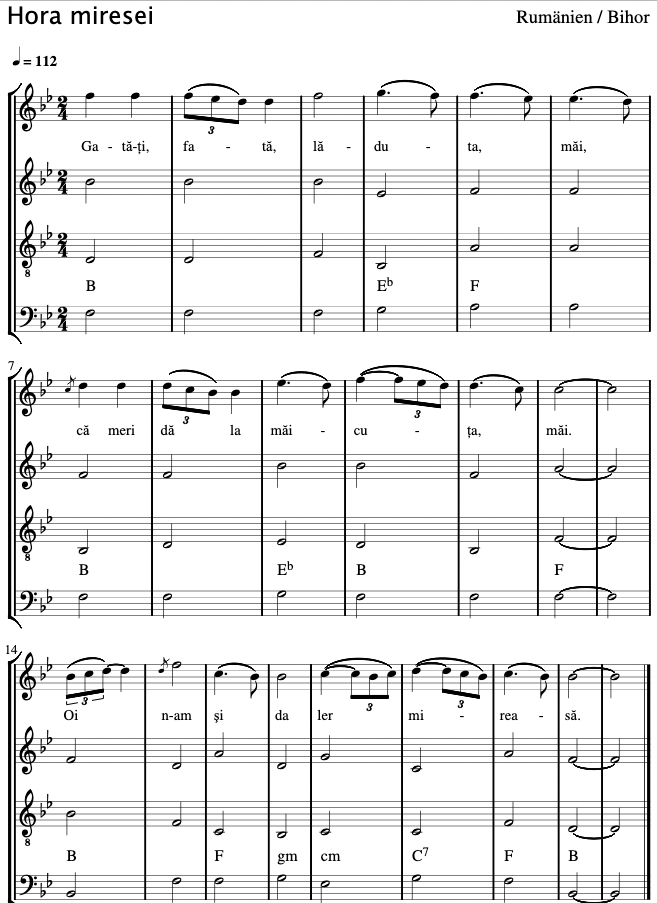
Gata-ti fata laduta,                    Finish, girl, your dowry
Ca meri di la maicuta,              you are leaving your mother.
Oi n-am si da ler mireasa.       Sheep I have not for the young/charming bride.
Gata-ti fata poalile,                   Finish, dear girl, sewing your skirts,
Nu cata la alt mire,                    don't seek another groom.
Oi n-am si da ler mireasa.       Sheep I have not for the young/charming bride.
Lasa-ti fata hainile,                   Finish, dear girl, your clothing,
Ca meri cu zadaile,                   for you are leaving with your zadanile*
Oi n-am si da ler mireasa.       Sheep I have not for the young/charming bride.
Peste munti la alte curti,          Over the mountains to other houses
La parinti neconuscuti,            to unknown parents**.
Oi n-am si da ler mireasa.       Sheep I have not for the young/charming bride..
Iesi maicuta pin-afara,             Come, dear mother, outside
Si pune propta la soare,           and hinder (prop up) the sun.
Oi n-am si da ler mireasa.       Sheep I have not for the young/charming bride.
Sa fie ziua mai mare,                To make longer the day,
Sa mai stam cu dumneatale,   to linger longer with you.
Oi n-am si da ler mireasa.       Sheep I have not for the young/charming bride.

Translation: Folk Dance Problem Solver, p.16.  ©1994, by Ron Houston
*You don't know what zadanile is?  Well, no one else does either.  Sounds to me [Ron Houston] like gifts.
**Compare this verse with Lucaci's comments: "And if many things may be overlooked and the girl marries the one beneath all of her requirements, at least he should be from the same village.  The separation from childhood surroundings is too hard and this is how the girl feels about leaving:
   Rather than live in strange lands
   With gold and bejeweled hands
   Better in your own town
   Without wealth, without renown.*
*http://*Larisa Lucaci, “The Romanian Wedding” in VILTIS 17:[1] (January-February 1958), p.11
Hora Miresei, the Living* dance
*a Living dance is a 1st Generation dance that is still performed in the country of origin (or immigrant communities) as part of a social event like a wedding where others can participate (not for an audience) by people who learned the dance informally (from friends and relatives by observation and imitation, not in a classroom situation). For more information, click here and here.
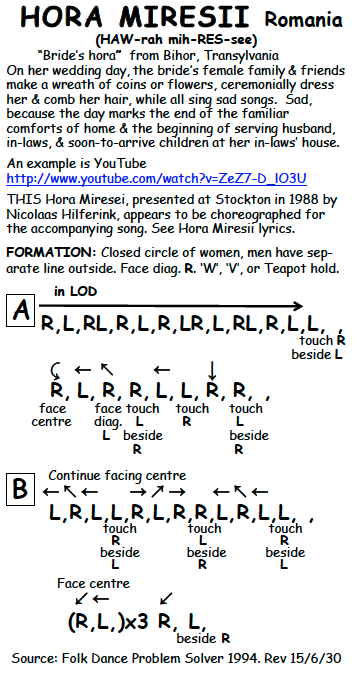
Hora Miresei (pronounced HAW-rah mih-RES-see) means “bride’s hora”. It is still danced at Romanian weddings. The simple, Living version can be seen here.
2nd G* dance – 2 versions
*2nd Generation dance. A dance that developed and was disseminated in a non-traditional way. 2G dances are specific – have a fixed format designed to correspond with the arrangement of a particular recording, whereas 1G dances are generic – have a shorter sequence that works with live music – where many different songs are played and arrangements vary according to the tastes of musicians and dancers. For more on the differences between 1st & 2nd G dances click here.
Because I could not find a YouTube example of Vasilescu/Hilferink’s Hora Miresei being danced in Romania, and because I have trouble believing the maids of honor would have the space to perform Vasilescu/Hilferink’s Hora Miresei in the confines of a peasant bride’s room while carefully dressing her, I have deduced this dance follows the “tradition” of creating a choreography to honor a beautiful song.
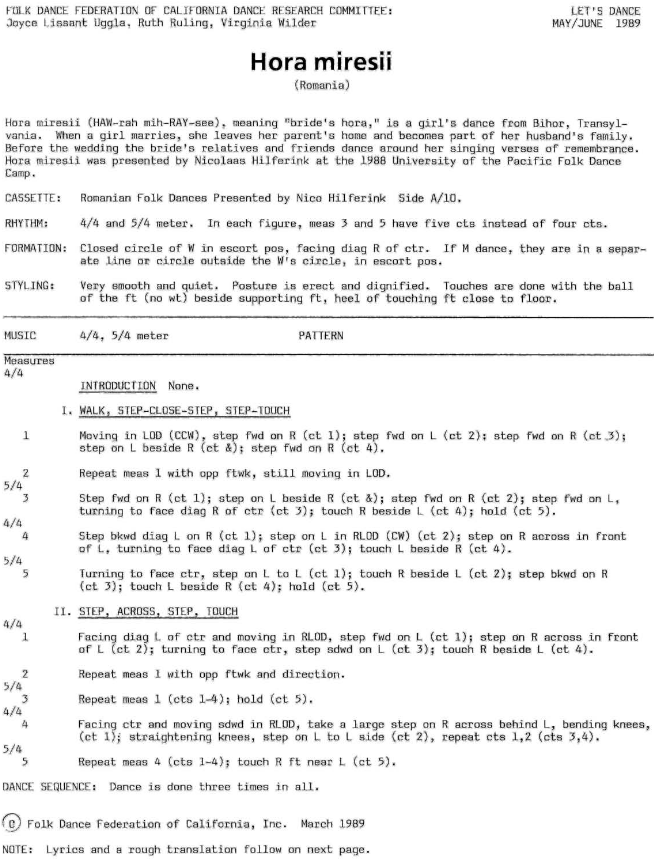
For RFD groups, a Hora Miresii was presented at Stockton in 1988 by Nicolaas Hilferink, which has become ‘standard’ in the recreational dance community. However, I recently got an email from Judy Stafford, saying “My understanding is that Teodor [Vasilescu] collected the dance in Romania (which doesn’t mean it’s not 2G), Niko learned it from Teodor, modified it, and then spread his version.” Here is a video of Teodor Vasilescu teaching his Hora Miresii.
Note some differences between the Vasilescu and Hilferink versions.
Vasilescu’s formation is a mixed line with hands held down, Hilferink’s is a women’s line in escort position. According to the ©1994 Folk Dance Problem Solver, Hilferink originally taught the dance as a closed circle of women with hands down or held shoulder-high. Within days of its teaching at Stockton the formation had been modified to escort position (R hand resting in crook of neighbor’s L arm) with men “in a separate line or at the end of the W line.” My understanding of Romanian dancing practices says this dance, whether it ever existed as a Living dance or only as a performance dance, would be danced by women only. So I’m guessing both Vasilescu’s and Hilferink’s formations are concessions to RFD dancing practices.
The dance steps start the same; R, L, RL, R, L, R, LR, L, but then Vasilescu goes R, LR, L, Close R to L, whereas Hilferink goes RL, R, L, Close R to L. The rest of part A (or I) is the same in both versions, as is all of part B (or II) Until the last 4 beats, where Vasilescu crosses R in front of L, while Hilferink crosses R behind – same as in the previous 3 crosses.
Hilferink then repeats Parts A (I) & B (II) two more times (3 total), but Vasilescu then repeats Parts A (I) & B (II) with opposite footwork and direction, then repeats the original Part A (I). (Still 3 total).
Below is Hilferink demonstrating his dance in Tuscon:
 Folkdance Footnotes