
Lioube, the Song
“Lioube” (Lyube Любэ) is a Russian girl’s name, and also the name of a famous Russian rock band.
The music for Lioube the dance is taken from the second album “Doinas and Dragons” by Szapora (pronounced SAH-poh-rah). Szapora says the song (no relation to the Russian rock band) is Russian Roma (Gypsy), but I can’t find any online references to a song by that name in English, Russian, or Roma languages.
However, a reader (see Comments below) has solved my dilemma!
Solnyshko                                                        The Sun
Oy, ne budite tume man maladova             Oh, don't you wake me the young,
Oy, paka solnyshko, romale, ne vzoidot.    Oh, until the sun, Romani, rises
Oy, luba ta luli chacho da ne                        Oy, luba ta luli chacho da ne
Oy, paka solnyshko, romale, ne vzoidot.   Oh, until the sun, Romani, rises.

Oy, denti, denti syvoneske volia -                Oh, give, give the grey horse freedom -
Yov vylydzhiala ke baht, ke dolia!                They bring him out to his happiness, to his fate!
Oy, luba ta luli chacho da ne                        Oy, luba ta luli chacho da ne
Yov vylydzhiala ke baht, ke dolia!               They bring him out to his happiness, to his fate!

Oy, denti, denti e vasta pshalenge,              Oh, give, give your hands brothers
Te avel e baht bari sare romenge.                And great happiness will be upon all Romani.
Oy, luba ta luli chacho da ne                        Oy, luba ta luli chacho da ne
Oy, paka solnyshko, romale, ne vzoidot     Oh, until the sun, Romani, rises.

Oy, paka solnyshko, romale, ne vzoidot     Oh, until the sun, Romani, rises.

Transliteration: https://lyricstranslate.com/en/%D1%81%D0%BE%D0%BB%D0%BD%D1%8B%D1%88%D0%BA%D0%BE-solnyshko.html

Translation: https://lyricstranslate.com/en/%D1%81%D0%BE%D0%BB%D0%BD%D1%8B%D1%88%D0%BA%D0%BE-dear-sun-2.html

Note that the Szapora version is somewhat abbreviated.  They sing the First Verse in its entirety, repeating the last two lines. Then the first two lines of the Second Verse, then repeat the 3rd & 4th lines of the first.
For their last verse, they repeat the first.
Szapora was formed by Dave Kelbie in 1997 with an original lineup drawn mostly from British members of the band The Budapest Cafe Orchestra. Late additions to the band were the incredible soulful voices of singing partnership Mirella and Tea Hodzic from Sarajevo who introduced a new repertoire which leaned more to traditional musics from former Yugoslavia allowing the band to explore richer, more nuanced emotional territory.
As a side note, Szapora, besides being a common Hungarian last name, has many meanings, including a Hungarian dance form, the fast part of a Csárdás, as in this YouTube.
Lioube, the dance
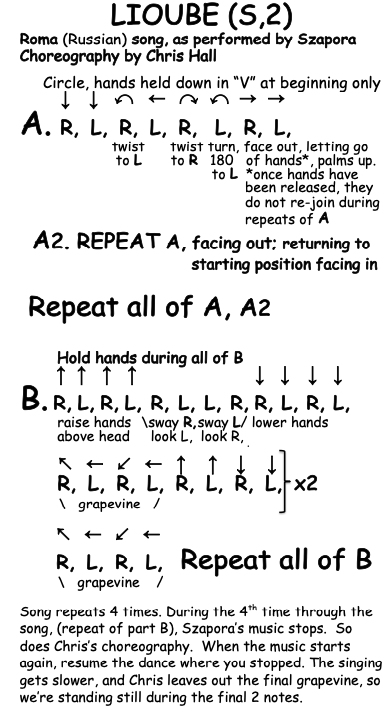
I object to Ira’s characterization of this choreography by Chris Hall as a “Russian Gypsy Roma Dance”. Chris Hall is not a Russian Gypsy Roma, nor does he claim his choreography has anything to do with Russian Roma. Indeed, it is unlike ANY Roma dancing I have seen. The song, (performed by British folk band Szapora) may be Roma, but NOT the dance! See WHOSE DANCE IS THIS? https://www.youtube.com/watch
COMMENTS:
bellatarantella wrote:
Thank you for this post – I spent some time looking into this song a couple of years ago after it had been on our circle dance repertoire. In the end I concluded that the song is a version of Nie bouditie / Solnyshko with a different lyric chosen as the title for the Szapora recording.
Here’s Nie bouditie with a different circle dance choreo (also in our repertoire): https://www.youtube.com/watch?v=UYz2m952YZQ.
And Solnyshko audio https://www.youtube.com/watch?v=qDFAmtlsuw4
Also in transliteration https://lyricstranslate.com/en/%D1%81%D0%BE%D0%BB%D0%BD%D1%8B%D1%88%D0%BA%D0%BE-solnyshko.html
I found this version with lyrics in russian/romani and english: https://lyricstranslate.com/en/%D1%81%D0%BE%D0%BB%D0%BD%D1%8B%D1%88%D0%BA%D0%BE-dear-sun-2.html– the translation isn’t elegant, but it switches languages within phrases, so it’s not easy! I consulted a Russian speaker to make sense of it.
Don replied: Thanks so much for all your sleuthing, and for sharing it with my readers!
rickbking wrote:
The music is pretty consistently identified as Russian Roma, but its name in English is clearly not consistent.
Another Israeli dance masquerading as a Slavic/Roma dance from Eastern
Europe. Israeli dance is fine for what it is, but it should be kept
separate from Slavic and Roma dance. More and more of these dances are
popping up using music that isn’t dance music (in the traditional sense
of music that makes you want to dance).
Alan Trangmar wrote:
Thanks for unearthing a translation, otherwise hard to find.
I notice a rather jaundiced comment down the bottom which seems to me inappropriate on an informational website: “Another Israeli dance masquerading as a Slavic/Roma dance from Eastern Europe.”
The dance is described as a circle dance choreographed by Chris Hall that uses a track Lioube from a CD by Szapora : who are a mainly-UK band who describe the track as “traditional Russian gypsy”. I don’t know anything about Chris Hall but from his presence on the Mandy de Winter video I guess he is probably a British circle dancer. There is no pretence here!
I agree that describing it as a “Russian Gypsy Roma dance” is misleading – but that is not the fault of Chris Hall. And a dance does not in itself “masquerade” as anything.
I am not aware of any Israeli connection.
And although many Roma live in areas with mainly Slav-speaking populations, “Slavic/Roma” is a rather strange combination term. Simpler just to say Balkan, to avoid excluding the Romanians, Greeks and Albanians.
Of course if one is to get analytical, Lioube has much the same status as many well-established “folk” dances like Cobankat and so on: one could have an interesting discussion about the extent to which some of these dances fit within a Balkan tradition, but it is clear that if one were to travel to Albania, if one did find anybody dancing our steps to Cobankat, that would be because they had learned them from Youtube… (I hear a rumour that modern Macedonian Roma people now do Cocek in a style influenced by other countries’ dances seen on TV: purism is getting increasingly difficult).
Alan wrote in a further communication: “[I] live in the UK and I am active in both UK circle dance and UK international folk dance (I am the current lead organiser for Balkanplus in London): keeping a distinction between the two!“
 Folkdance Footnotes