
*2nd Generation dance. A dance that developed and was disseminated in a non-traditional way. 2G dances are specific – have a fixed format designed to correspond with the arrangement of a particular recording., whereas 1G dances are generic – have a shorter sequence that works with live music – where many different songs are played and arrangements vary according to the tastes of musicians and dancers. For more on the differences between 1st & 2nd G dances click here.
**S stands for Song, a category I apply to part of the repertoire of recreational folk dancers. Songs are just that – songs, or sometimes merely melodies, that are well-known in their country of origin, but aren’t necessarily associated with any particular dance. They may be traditional folk songs, or pop songs written in the folk style, or ‘pure’ pop creations that are dance-able. People will dance to them, but there is no culturally agreed upon ‘traditional’ dance that is particular to that song, just as we don’t associate any particular dance with “Blowin’ in the Wind” or “Lady Madonna”. For more about songs vs dances, click here.
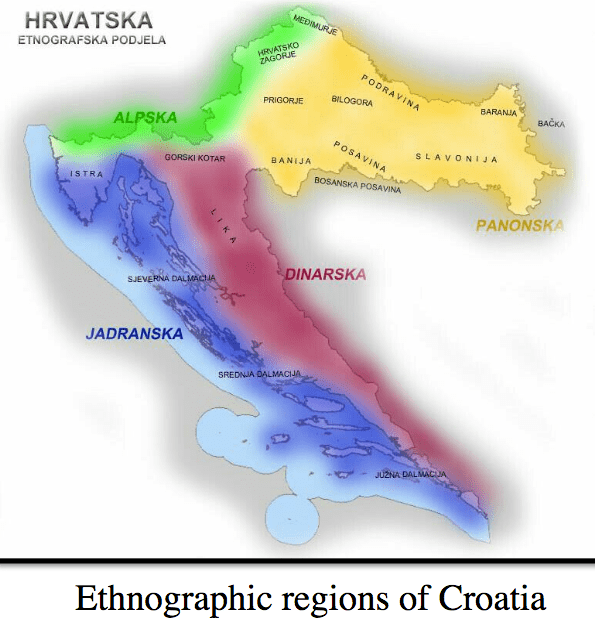
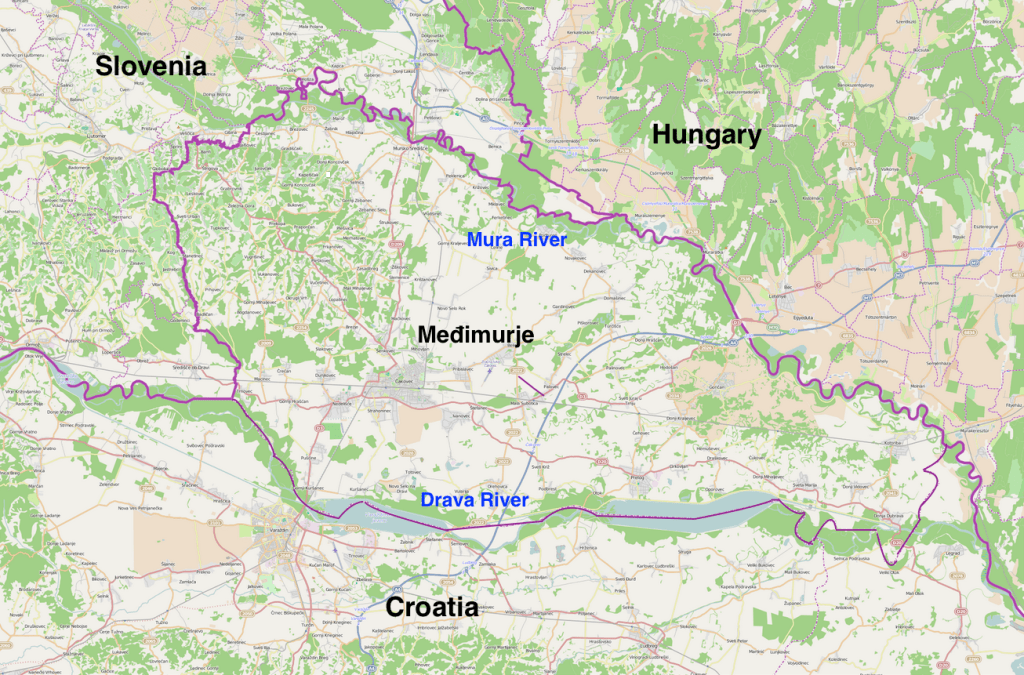
Settled by humans since the stone age, its history is the usual stew of migrations (Celts, Serets, Pannons, Huns, Visigoths, Ostrogoths, and, in the 6th century, Slavs) and occupations (Romans, Lombards, Ostrogoths, Avars.) In 896, the Hungarians occupied, and since then control has mostly been a struggle between Slavs and Hapsburgs/Hungarians. The land was mostly part of Hungary until 1918, but Slavic control was not stabilized until 1945. Hence the culture is Slavic with heavy Hungarian and some Germanic influences.
THE SONG
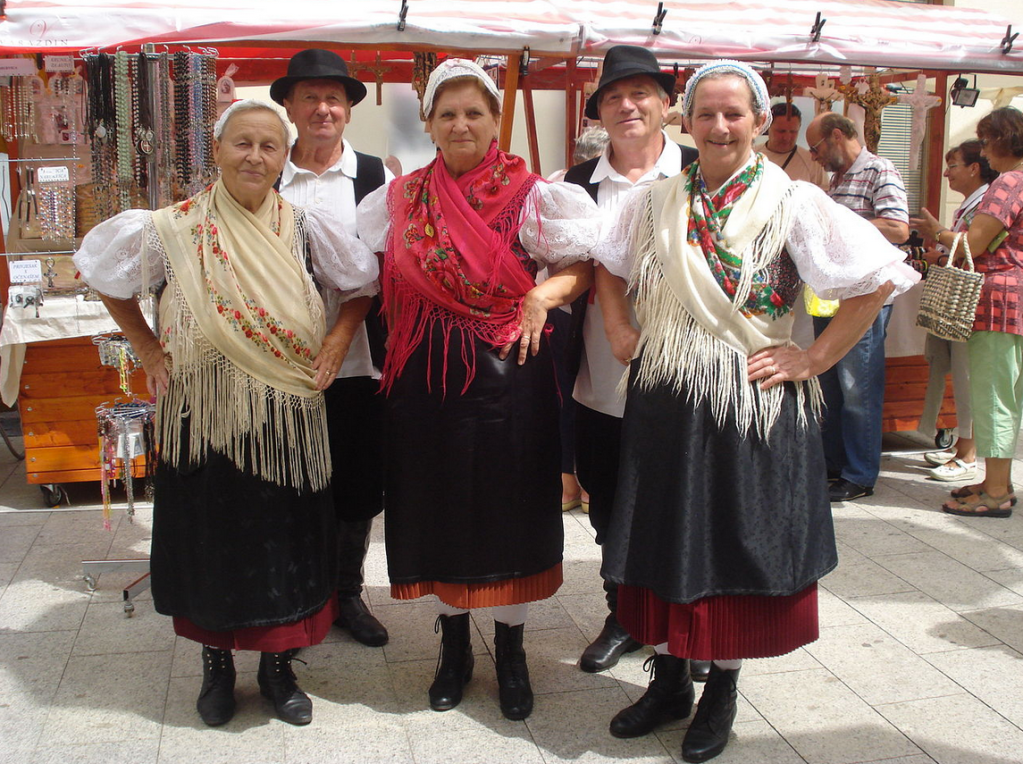
Pet je kumi v jedni kleti is a folk song from the Međimurje region. The oldest recording I can find for it dates back to only 1987, on an album by the Los Angeles folk choir Nevenka. https://nevenkafolk.bandcamp.com/track/hodi-tichek-mene-pet-je-kumi-v-kletl However an undated LADO recording (below) is likely much older, and all seem to consider the song to be traditional.
NOTE: All of these versions below (except the Željko Jergan) have a melodic structure of 4 sets of 6 counts (4×3 measures) each equals one verse – 3 singing sets of 6, and one instrumental set of 6. The Željko Jergan dance requires 12 sets of 6 counts – 8 singing sets of 6, and 4 instrumental sets of 6.
Lyrics for Potočnik recording:

///Pet je kumi v jedni kleti saka skoro bez pameti.///
Prva veli pijte kuma bute mali već razuma
//Druga teško si zdihava v puni pehar nalukavla//
Trejta pak po stolu ruži i na muža jako tuži
//Četrta veli nije šala kaj sam skoro v blat opala//
Peta si pak premišlava jel bi čerku zamuž dala
// il bi sebi dečka zela il bi njemu čerku dala //

Google translation:
///Five godmothers in a wine cellar are almost out of their heads [with drink-DB]///
The first one says, "Drink godmother, be small, but be sensible."
//The other sighs heavily into a full cup of nalukavla //
The third blushes at the table and complains a lot about her husband.
//The fourth says it is no joke that I almost fell into the mud //
The fifth one, on the other hand, is thinking about giving her daughter a husband
//Either she wanted a boyfriend, or she would give him a daughter//
///Pet je kumi v jedni kleti///
saka skoro bez pameti.

Prva veli pijte kuma bute mali već razuma
????????
Prva veli pijte kuma bute mali već razuma

Druga ?????????
?????zdihava v puni pehar nalukavla

Instrumental interlude

Trejta pak po stolu ruži i na muža jako tuži
??????????
//??????????//

Četrta  ??????????????
//???????????//

Instrumental interlude

Peta si pak premišlava jel bi čerku zamuž dala
// il bi sebi dečka zela il bi njemu čerku dala //
If anyone can supply a translation for my ????, or make more sense of my Google translation, I’ll be happy to credit you!
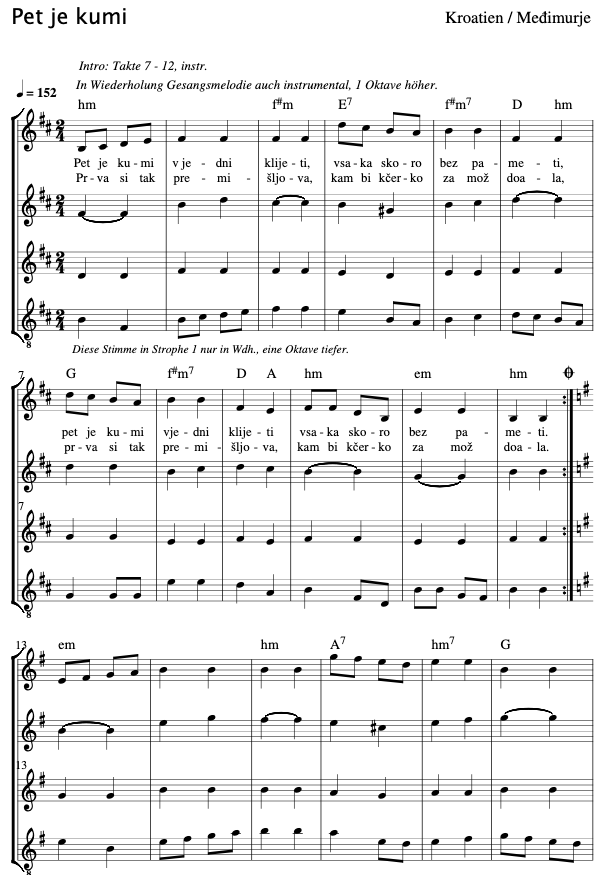
SHEET MUSIC

THE DANCE
In 2015 Željko Jergan taught his choreography for the song at Stockton. Below are his notes. Željko uses yet another recording for his dance (is that Željko singing?), with somewhat different lyrics, arranged differently to match the choreography. The Željko Jergan dance requires 12 sets of 6 counts – 8 singing sets of 6, and 4 instrumental sets of 6. After the intro, the dance is performed exactly 3 times.
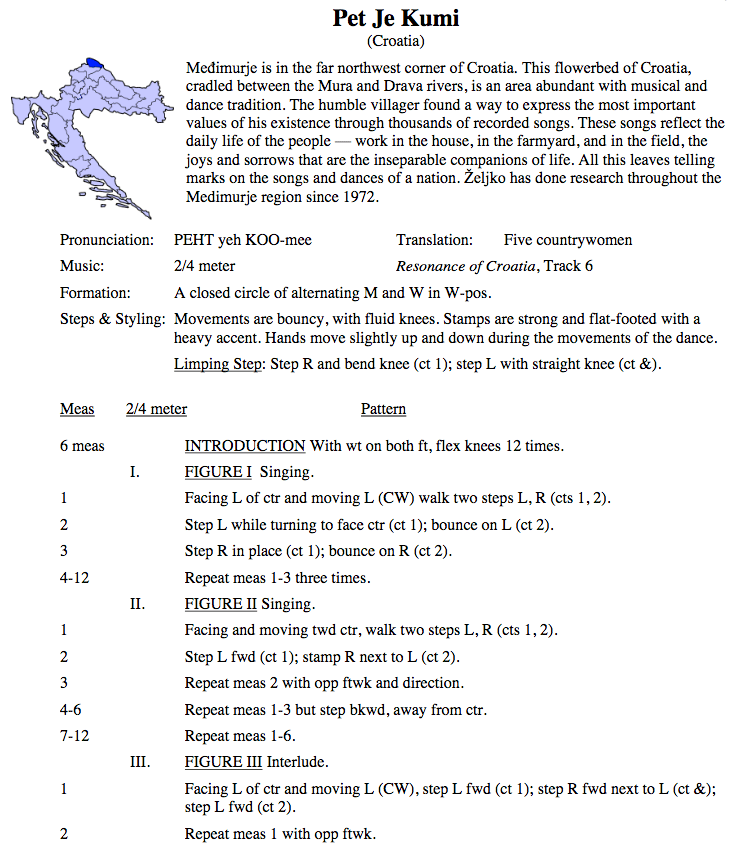
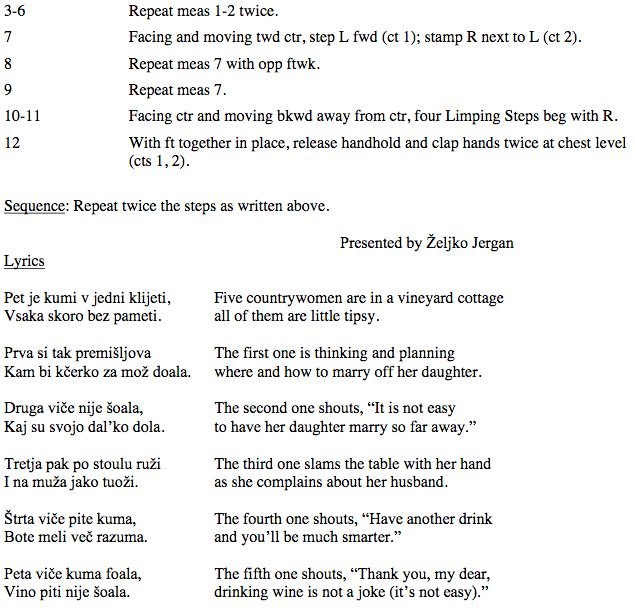
http://www.folkdancecamp.org/assets/PetJeKumi-SFDC2015.pdf
COMMENTS:
John Uhlemann wrote: Lado made several versions of its best repertoire. In his liner notes for the teaching CD of this dance, Željko Jergan said the original to the music he used was arranged by Božo (Božedar) Potočnik. The music from Međimurje has a Hungarian sound for the reasons you mentioned. Jeljko said that local songs and dances were suppressed by the Hungarians and, while some of the songs were remembered, the dances were all lost. After WWII, when the area became part of the Croatian republic of the new Yugoslavia, dance instructors came in and created dances for the region to some to the surviving songs. Many of them stuck and became part of village repertoire; others survived only in performing groups. Raca Plava is an example of this. I am not sure which category Pet je kumi is in, or if it is a newer creation.
 Folkdance Footnotes