
*S is for Song ** 2 is for 2nd Generation dance
Tino mori – the Song
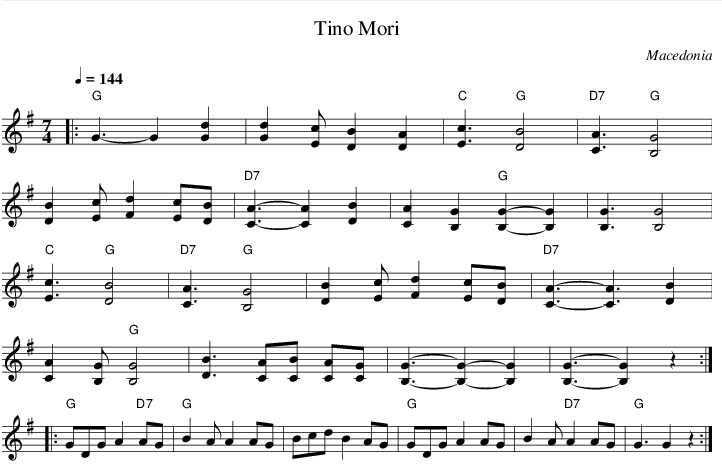
Tino mori – the 2nd Generation Dance
Atanas Kolarovski [the choreographer of Tino mori] was asked to help form Tanec, the Macedonian State Folk Ensemble, where he remained for 19 years as artistic director, choreographer, and lead solo dancer, traveling the world for 16 of those years. Source: https://sfdh.us/encyclopedia/kolarovski_a.html
In 1955, Kolarovski-led Tanec became the first of the Moiseyev-influenced performing groups from Communist countries to tour the United States. Their impact on the folk dance community was electric (see the chapter The Impact of Performing Groups in Phase 3 of A Subjective History of Recreational (International) Folk Dancing in the USA – 3. Tino Mori was a song with choreography featured in that first tour.
Elsie Dunin and Stanimir Višinski (Dances in Macedonia: Performance Genre Tanec, 1995) exhaustively researched the Tanec ensemble repertoire and said this about Tino mori:
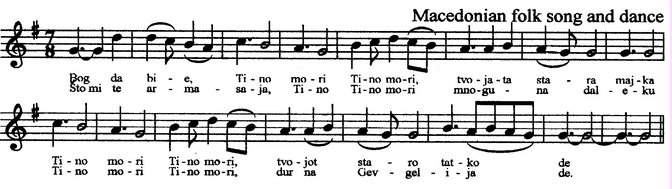
This is one of six dances “adapted” to a song already popular during the 1940s. … Arranged to the song Tino Mori, the step pattern matches the melodic phrasing as is common with other “adapted” dances performed by Tanec. The name appears in a Tanec program in 1953 within a set of songs and dances referred to as “sobor,” danced by both men and women.
The Tanec dance resembles but differs considerably from Atanas Kolarovski’s dance, done in the U.S. Source: Folk Dance Problem Solver ©1993 by Ron Houston. Used with permission.
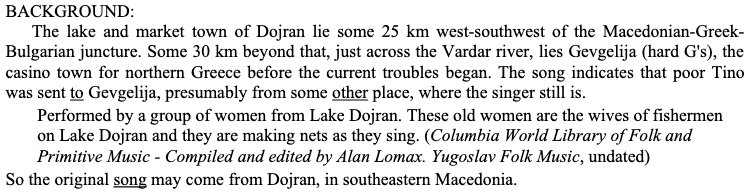
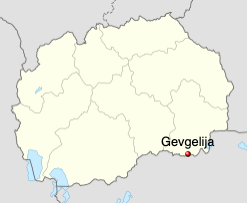
As far as I can tell, there is no traditional dance associated with the (traditional?) song Tino mori. Below are the two YouTubes I can find of people, located in the Balkans, moving to the song.
Below: Google Translate would only translate the name of the TV show “iselenicki dzuboks” from Serbian (not Macedonian or Bulgarian): “Expatriate Jukebox”, so I assume this is a show for Expat Slavs from other countries now living in Serbia. Note the dance being performed behind the musicians, first by a performing group in costume, then joined by the audience. It’s a simple walk, walk, step, touch, step, touch – the most universal dance in the Balkans – what I call the Taproot Dance or T-6.
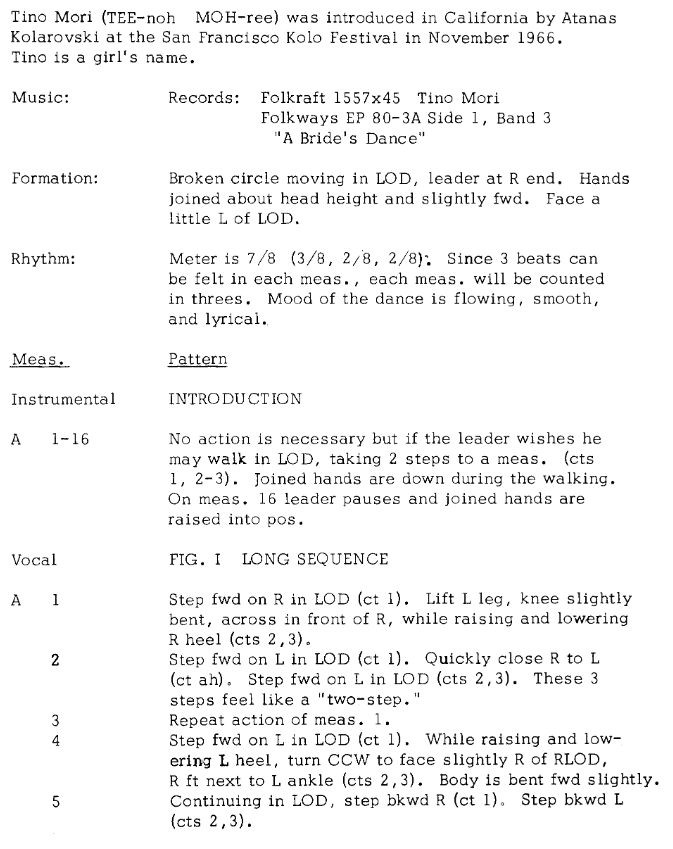
More information on Tino mori can be found here: https://sfdh.us/encyclopedia/tino_mori.html

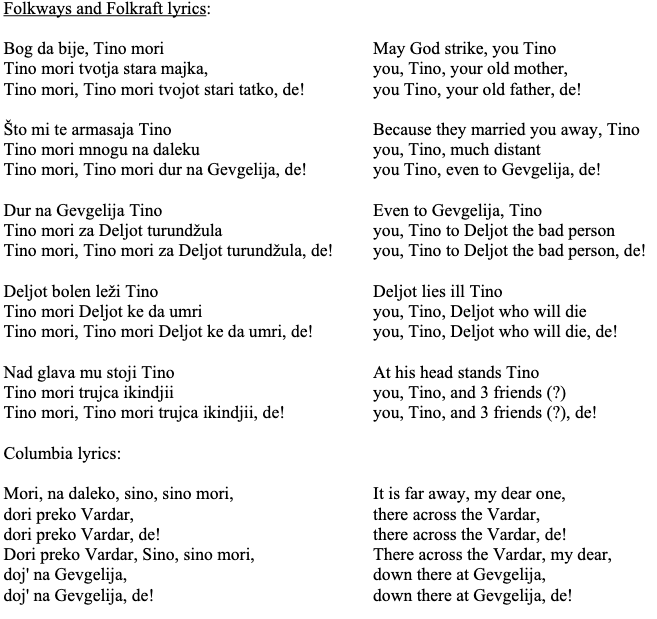
COMMENTS: michael-leonard wrote: I still have some problems with the translation:
I don’t think the singer means for god to strike Tino, but her parents, for marrying her off to Deljo. He keeps calling her Tino mori, which means my Tina (not you). And who IS Deljo, anyway? There is a famous Deljo the Haiduk, which might explain why he lies dying. What is Turundzula? I can’t find any Macedonian word that is even similar. And all translations I can find for English words for bad people don’t match; ikindzii isn’t friends, that’s prijateli – same number of syllables. but, again, I can’t find that word anywhere.
Don replies: I’m no linguist, but I try to include translations from reputable sources. However in this “updated” version I left out a reference that might be of some help, found here https://sfdh.us/encyclopedia/tino_mori.html It’s Dick Crum saying how he got his translation for Tino Mori.
Since I was cited somewhere along the line as the source for the MIT Folk Dance Club Songbook‘s version of “Tino mori,” I thought I’d add my two cents to the discussion. Yes, it was me. I wrote down the words and translation for it and a couple other Macedonian songs about three years after the Earth cooled, seated with a small group of Tanec members, including Atanas Kolarovski, in a kafana. They explained words I didn’t know: “ikindziji” = “doctors,” “armasam” = “to send away to be married,” “Deljo Turundzula” = “some Turkish personage (nobody knew),” and a few others.
 Folkdance Footnotes