
“Dunavsko Horo is the favorite horo chain dance of all Bulgarians – said Iva Todorova, Co-founder of “Taratantci” Foundation, a creative organization with a cultural focus intended to make Bulgarian folklore accessible in modern times. – New Year always begins with this popular chain dance. People from all parts of Bulgaria dance “Dunavsko Horo”, although it was created in Northern Bulgaria. It is named after the popular piece of composer Diko Iliev, written in the remote 1937. It has various names, associated with the areas located along the Danube River and Central North Bulgaria. We also call it Svishtovsko, Tarnovsko and Severnyashko. We make five steps forward and three steps back when dancing this horo chain dance, which goes to show how important it is to be two steps ahead.” Source: https://bnr.bg/en/post/101579386/dunavsko-horo-chain-dance-the-invisible-thread-that-connects-bulgarians-around-the-world
The Music
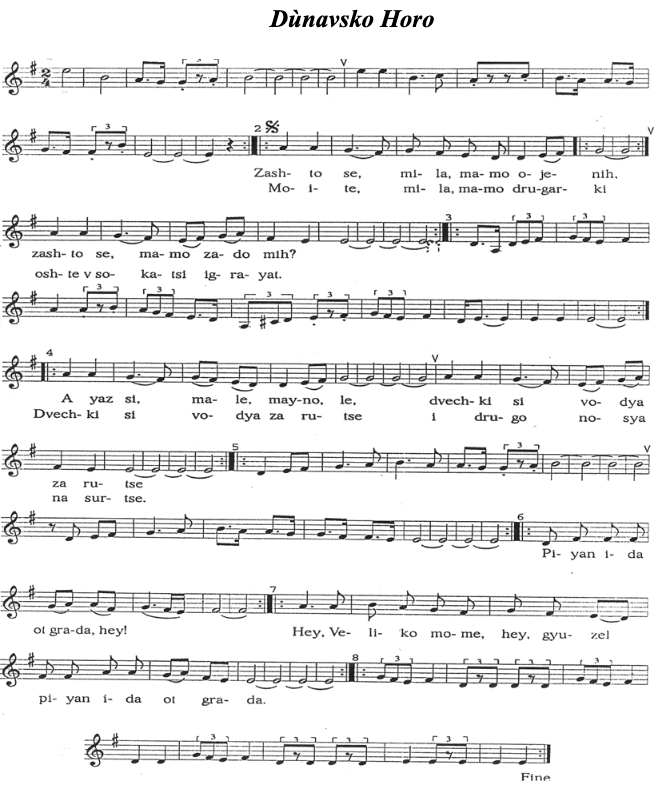
[The music was] Written in April 1937, when the composer Diko Iliev was working in the orchestra of the Thirty-sixth Infantry Regiment of Kozloduy in Oryahovo, originally arranged for brass band, it is a pravo horo in 2/4 time.
The master of the people Diko Iliev was born in 1898 in the village of Karlukovo, now municipality. Lukovit.
During the first years of his career, he was part of the brass band of the 16th Lovchan Regiment, then he worked in the Sofia National Opera. In 1920, for financial reasons, he left Sofia and went with his wife Anastasia to the village of Voivodovo, near Byala Slatina. Played and composed, created brass bands throughout the region of Vratsa and Montana (then the town of Ferdinand).
In 1931, after the creation of the military brass band in Oryahovo, Diko Iliev joined it. He briefly worked in Sofia again, but returned to his beloved Oryahovo.
In 1937, he composed “Danube Horo”, which became one of his most emblematic works. “One spring evening he comes up with the melody of this dance, sits down on a three-legged stool, writes down the notes, plays it on the accordion, runs to Weiner in the morning, shows him the notes, they play it together, and everyone likes it. And at the first opportunity, they played it in front of an audience in Oryahovo… its premiere was on the square in Oryahovo,” says writer and publicist Borislav Gerontiev. Later, this choro was recorded for the first time by the orchestra of Transport troops.
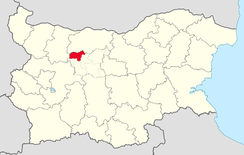
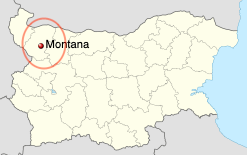
After decades of fruitful activity, Diko Iliev died in 1984 in Montana [Bulgaria]. In his memory, festivals of the “Diko Iliev” brass bands are also held in the regional town. When considering the musical work of Diko Iliev, the musicologist is not suffocated by the usually complex scores of the classics or the romantics. Before his eyes and ears floats a music born from the heart, clear, crystal clear, written with joy and inspiration by a musician armed with modest compositional skills, but with an extraordinary sense of form for building the musical work. A musician who received recognition from God, born, created to create as spontaneously as Mozart did.
Bai Diko, as the people call him, makes the Bulgarian people dance to his music. Now and forever, no Bulgarian can imagine Bulgaria without Diko-Ili’s “Danube Choir”. This is a masterpiece that ranks next to “Edin Zavet”, “Bdinci Lions Titans”, “Great is our soldier”… Diko Iliev wrote about 70 choruses – pravos [2/4], daichovos [9/8], eleninis [7/16], 20 marches, dozens of waltzes, etc. It is no coincidence that in many settlements in North-West Bulgaria they accept it as their own. In Montana, where he died on a cold December 12th day in 1984 at the age of 86, his name is proud as a national hero.
The composer is the only Bulgarian who participated in 4 wars fought by the Bulgarian army in the last century. He wore a military uniform for 38 years. Maestro Diko Iliev (1898–1984) is to Bulgarian music what Ivan Vazov is to Bulgarian literature – a patriarch, a guiding star. And his Danube Chorus has long been OUR Danube Chorus. It really has a unique energy and something very simple about it. Even a person who cannot dance, if he listens, can feel the music that is played with wind instruments. Typically, hand movements are quite fast. The time signature is 2/4. The steps themselves – five forward and three back – show how important it is to walk, always two steps forward more!
Happy New Year!
#dunavsko horo #bulgaria ,#diko iliev Danube dance,#diko iliev,#diko iliev
Music 1 songs Hora [Romania] Nikolae Duta Brass Bands in Balkan Folk Music. https://www.youtube.com/watch?v=Q_2rJ0rGyhs
Sheet Music
The Dance
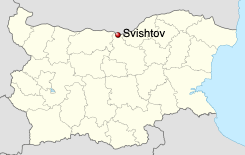
Dunavsko refers to a pravo-based 4-, 6-, or 8-bar* dance originating in towns along the Danube River in but now known throughout Bulgaria..
The dance is based on a simple [6-bar*] pravo horo, and many variations are possible. It seems most popular to move the arms forward and back quickly on the beats (Philip Koutev Ensemble version) rather than the slow down and back over two bars (Horo.bg). Source: https://www.fortcollinsfolkdance.org/dances/pages/bulgaria/dunavsko-horo/
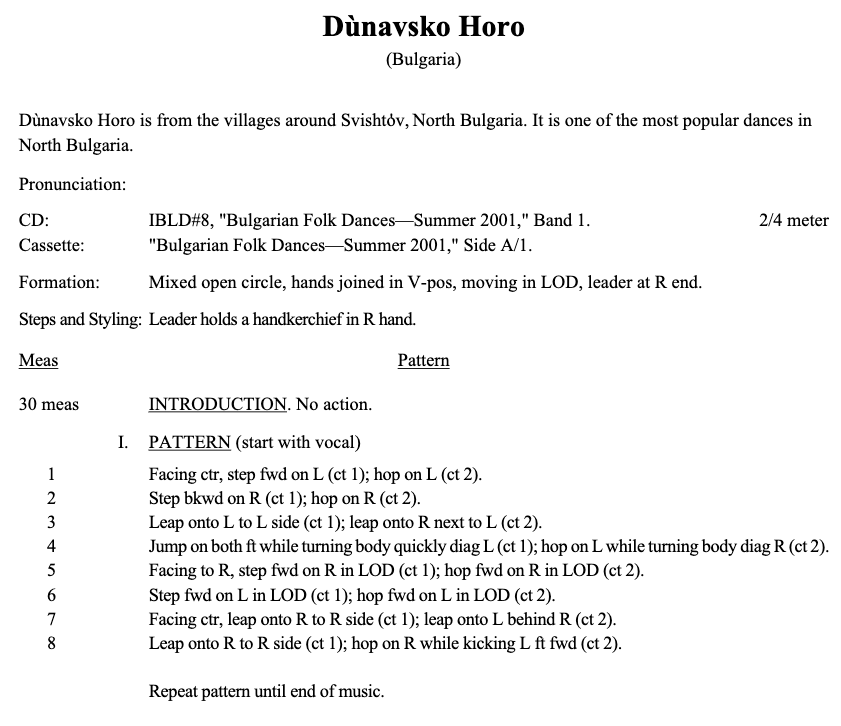
Although the 6-bar* Dunavsko is the most popularly taught dance outside of its Danube region origin (see all versions below), some towns on the Danube also feature an 8-bar dance (Svishtovsko horo), and performing groups use a 4-bar* version to display and transition between various formations. The 6-bar* version just happens to be another iteration for for the Taproot T-6 & Taproot T-12.
*For those not trained in reading music notation, a bar is the vertical line separating measures. In the instance below, there’s a line between -to and se, between se and mi-, between mo and o-, between je- and nih, and separating the 2 notes of nih. Within each pair of vertical lines is a measure, often shortened to “bar”.
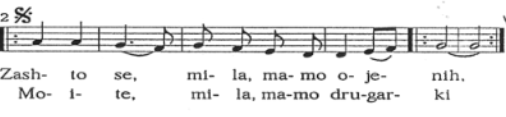

At the beginning of the music, you’ll see these symbols and numbers. The only thing you need to know now is the 2 over 4. The top “2” says how many beats are in a measure, or ‘bar’ (the number of beats between a pair of bars, in this case 2). The bottom “4” says what constitutes a beat – in this case a quarter note, which looks like the notes above “Zash-to”. So 2 beats to a bar, a quarter note gets one beat. Each of these measures, or bars, adds up to 2 beats, even though they sometimes have many more (or less) notes. That means some notes last longer or slower than others, but no matter how many notes are in a bar, each bar contains a total of 2 beats.
Fortunately for us, Dunavsko horo has steps that are all the same length – one beat each, or 2 steps to a bar. A hop (or a kick) counts as a step, and is also one beat long, so the first bar consists of a step and a hop.
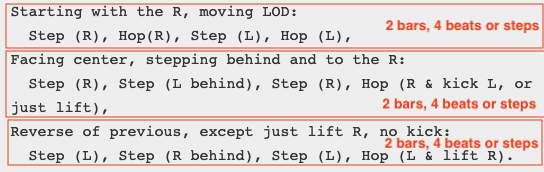
8-bar dances – Dunavsko & Svishtovsko
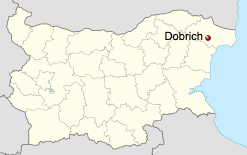
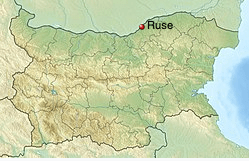
A member of Gabriola Island’s Caravan Dancers group (Canada), Nelly Madan, was born and raised in Ruse. Nelly says she was taught this 8-bar pattern in school in Ruse during the end of the Soviet period, and that it was called Dunavsko. It was danced throughout the year, but especially just after midnight on New Years Day, when people would dance in the streets.
4-bar dances
COMMENTS:
John Uhlemann wrote: While clubs and performing groups al do it the same way, the Bulgarian immigrant communities of Chicago and St. Louis come from various parts of Bulgaria, including the north, so what I have seen socially is only the 6-measure dance, but disagreement over the arm swings.
 Folkdance Footnotes