
*a Living dance is a 1st Generation dance that is still performed in the country of origin (or immigrant communities) as part of a social event like a wedding where others can participate (not for an audience) by people who learned the dance informally (from friends and relatives by observation and imitation, not in a classroom situation). For more information, click here and here.
I am grateful to Yvonne Hunt, Greek dance authority, who graciously took time from her very busy schedule to preview this article. Her insights are sprinkled throughout.
Karagoúna can mean many things….
KARAGOÚNA – the People
A Karagoúna is a female of the Karagoúni (Karagoúnis, Karagoúnides) people – a distinctive group of Greeks. Their dialect is distinctive, their history is long, and their location is particular. They are often confused with other Greek nomadic pastoralists (sheep and goat herders), the Koutsovlachs, Arvanitovlachi, and Sarakatsans, who occupy overlapping, though larger, territory. For more on this subject, see https://folkdancefootnotes.org/culture/ethnicity-history-geography/koutsovlachs-arvaniti-karagouni-sarakatsan-greek-shepherds/
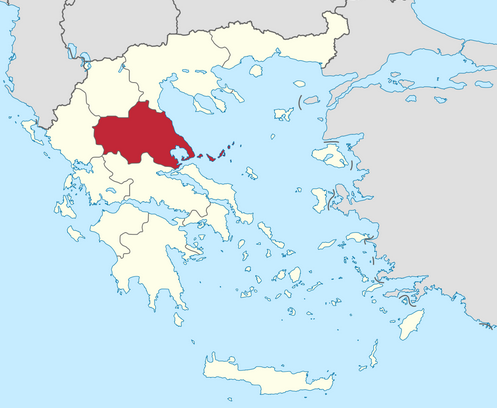
Not much is available online about the Karagoúnides, though every Greek knows of them and has a theory about where they came from. Wikipedia says almost nothing: “Karagoúnides (Greek: Καραγκούνηδες; singular: Καραγκούνης, Karagoúnis) is the name of the native people of the western plains of Thessaly, Greece. More specifically, the term is used to refer to the inhabitants of the lowland farming communities of the Karditsa and Trikala regions, and the area around the city of Farsala.”
My best source so far has been this blog: http://folkcostume.blogspot.com/2013/10/costume-of-karagouni-thessaly-greece.html “The Karagoúni are an ethnic group which inhabit the lowlands of western Thessaly, just east of the Pindus mountains. They mostly inhabit villages in the area surrounding the cities of Trikala, Karditsa, Sofades and Palamas. Some villages in the area are still inhabited solely by Karagoúni. They have retained their folk costume longer than many parts of Greece, many women wearing them daily well into the 20th cent. Today, a simplified form of this costume is popular with many Greek performing groups. The origin of the Karagoúni is unclear. Hatzimichali quotes several sources on this subject, which are rather muddled and which contradict each other. Some maintain that they are derived from Koutsovlachi (related to proto-Romanians -DB), others flatly deny this; some claim that they are Arvaniti [Albanian]*, some that they are Hellene in origin. They seem to speak no language but an archaic Greek dialect. They were not nomads or pastoralists, but farmers who were tied to the land in a feudal type plantation system called Çiftlik under Turkish occupation. [If anyone has more information on this, I would appreciate being better informed]. Starting about 1889, they began to take ownership of the land which they farmed, as the feudal Çiftlik system began to break up.” * Yvonne Hunt’s comment “I sincerely doubt the mention of an Arvaniti tie since their only language is Greek.”
For more information on Karagoúna costumes see https://folkdancefootnotes.org/clothing/karagouna-costume/
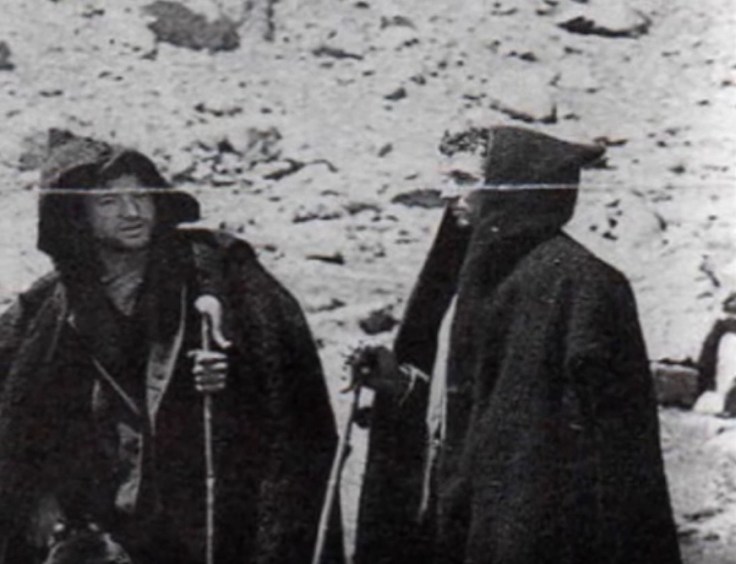
Karagoúni translates either as “wearers of black capes” in Turkish [source:http://www.farsarotul.org/nl2_3.htm], or “head/fur” in Greek [source:Athan Karras/Greek dictionary via Rou Houston]. The name refers to the hooded goats’ hair cape/cloak/coat worn by all Greek nomads in winter. Patric Leigh Fermor, in his classic book Roumeli (1966), sorts out the Karagoúni, Koutsovlachs, Arvaniti, and Sarakatsan. For the details, see https://folkdancefootnotes.org/culture/ethnicity-history-geography/koutsovlachs-arvaniti-karagouni-sarakatsan-greek-shepherds/


KARAGOÚNA, the Song
Music of the Karagoúni is the music of Thessaly in general – solemn, ‘stately’ is a term often used. A song and dance widespread in Thessaly is Svarniara. Elements of the tune and dance we know as Karagoúna are part of many versions of Svarniara.
Neos Kosmos, https://neoskosmos.com/en/a website for the Greek community of Melbourne, Australia, quotes Nick Papaefthimiou “The karagoúna is well known to everyone…The dance is generally referred to as svarniara and was originally orchestral but with time lyrics were added and has taken on the name karagoúna in reference to the lyrics. When ordering the song with lyrics the villages say “Vara to tragoudi”. Mr Papaefthimiou has been making regular trips to Greece to experience the traditions first hand from the primary source…even making his own field recordings. Yvonne Hunt’s comment: “He writes as if there is ONE dance and one song–not so.”
The melody sounds a lot like Svarniara. https://www.youtube.com/watch?v=qEjPzKVYy58
For more YouTubes of Svarnia/Karagoúna music, see https://folkdancefootnotes.org/music/karagouna-svarniara-music-youtubes-greece/ Yvonne Hunt’s comment: “Note the same tune is sometimes called Svarniara and at other times, Karagouna.”
For lyrics to some of these songs, including English translations, see https://folkdancefootnotes.org/music/karagouna-english-lyrics/
KARAGOÚNA, the Living Dance
Yvonne Hunt, in Traditional Dance in Greek Culture, 1996, writes “The Karagoúnides (Garagoúnides, as they refer to themselves) , according to research done by Apostólis Firfiris, whose mother was a Karagoúna, are found in four main centers of Thessaly:, Karditsa, Sofádes, Palamás, and Fársala. In each of these centers they perform their own versions of the dance we call Karagoúna. In each case it is a simple dance usually consisting of one step done repeatedly. It may be like the sta tria [Taproot dance, DB], or a simplified version of syrtos. Never, however, does it take on the choreographic form of several changing steps ending with a lively syrtos that is presented by almost all of the performing groups in Greece and abroad.” Since that was written, apparently most performing groups in Greece have reverted to showing the ‘village’ version.
Copies of Yvonne Hunt’s book Traditional Dance in Greek Culture (in my opinion the best book in English on the dances od Greece) can be purchased directly from Yvonne; email – yhunty@yahoo.com, or Facebook. Yvonne has another, more detailed book, also for sale, covering the Serres region – A Nest of Gold (2014).
Ted Petrides, in his 1976 book ‘Greek Dances and How to Do Them’ writes “when the Karagoúna is danced by the people known as the Karagounoi who live in Karditsa, Thessaly, it is often danced as a simple sta tria [Taproot dance, DB]. However, when middle-aged and older people dance the Karagoúna, they tend to use no particular set pattern: the leader performs steps as he sees fit, and the rest of the dancers perfrom steps similar to his as best they can.” Nowadays Karagoúna is danced mostly by women.
Yvonne Hunt’s comment: “However, if one looks about halfway through the video, they are all basically doing the same step. The leader has the right (obligation???) to perform his or her variations.” https://www.youtube.com/watch?v=2-m2bImxJ0E
Yvonne Hunt’s comment: At about 4.44 the melody changes to Dailiana. Some Karagoúnidhes dance it as Tsamikos, others have a specific different dance for it. https://www.youtube.com/watch?v=hzd3Jnr-_7o
I found 34 YouTubes of “villagers” dancing what they labeled as Karagoúna. In 6 of those YouTubes, someone was leading a line doing the sta tria step, while other lines were doing syrto. In none of the YouTubes was everybody doing the sta tria step. The remaining 28 YouTubes, showed everyone doing a syrto. No one was doing anything fancier, like changing footwork to another step, even on the rare occasion when the music suddenly speeded up. Yvonne Hunt’s comment: “And yet, there are other ways to dance it depending on the village.“
Svarniara, the Living Dance
Yvonne Hunt, in Traditional Dance in Greek Culture, adds “Another dance that is often the cause of confusion is the Svarniára. In actuality it is the name of a song and there may be a variety of different dances done to it. Quite often a sta tria is danced. Some Karagoudines dance the Karagoúna to this music. In the Fársala region while the women danced their version of the Karagoúna the men frequently danced sta tria [Taproot dance, DB], consisting of 8 counts rather than the usual 6, that is taking 5 walking steps to the right rather than the usual 3.”
Yvonne Hunt’s comment: “Exactly right. There seems to be no cut and dried division.” http://ΣΒΑΡΝΙΑΡΑ ΚΙΤΣΟΠΟΥΛΟΣ ΧΡΗΣΤΟΣ ΚΛΑΡΙΝΟ !!!
Performing Groups – Karagoúna
I found 17 YouTubes of Greek performing groups dancing a simple version of Karagoúna – often dancing identically to the ‘village’ version. One of the few differences was that some performing groups danced the 1st six steps of their syrto in a QQS rhythm, reverting to SQQ for the 2nd six.
There are 2 YouTubes of Greek performing groups executing the steps and change sequences to a dance called Karagoúna that is almost identical to the dance recreational folk dancers know. One was made in 1993, the other in 1982. As I can find no Living ‘village’ examples of this choreography in Greece, no historical references, and no current Greek performing groups using this choreography, I’m calling it a 2nd Generation dance – not ‘village’, but Greek performance in origin. You can see these YouTubes here: https://folkdancefootnotes.org/dance/a-real-folk-dance-what-is-it/2nd-generation-dances/karagouna-2nd-g-greece/
Performing Groups – Svarniara
Svarniara is the opposite of Karagoúna, dance-wise. While Karagoúna performances are simple with little variation, Svarniara performances range from simple to highly choreographed.
Choreographer: Periklis Diamantis https://www.youtube.com/watch?v=zWxT7lXtWU8
Here’s the complete quote by Nick Papaefthimiou from Neos Kosmos, cited above; “The karagoúna is well known to everyone but for many years a modern version was performed by dance groups accompanied by a modern song, which included a kalamatiano transition which the karagounides refer to as the pallavi (crazy) karagoúna. The dance is generally referred to as svarniara and was originally orchestral but with time lyrics were added and has taken on the name karagoúna in reference to the lyrics. When ordering the song with lyrics the villages say “Vara to tragoudi”. Mr Papaefthimiou has been making regular trips to Greece to experience the traditions first hand from the primary source. He has been collecting authentic traditional original folk costumes and musical instruments in several regions of Greece and learnt dance steps and vocals of various style, even making his own field recordings. Below is the “crazy” Karagoúna.
CONCLUSION:
Karagoúna is the name of a female of a distinct group of people in Greece, concentrated in a few towns in Thessaly. It is also the name of several songs and dances, often also named Svarniara, that have associations with the distinct group, but also with Thesslay in general. The dance called Karagoúna or, commonly among the Greeks, Svarniara, has no fixed choreography and many regional variations, but usually is based on a simple syrtos or sta tria.
At one time, some Greek performing groups exhibited a dance they called Karagoúna that had “the choreographic form of several changing steps ending with a lively syrtos”. Recreational folk dancers learned this choreography, and many still consider it a Greek dance, but it is no longer danced that way by performing groups in Greece. Indeed, the “several changing steps ending with a lively syrtos” likely never was a ‘village’ dance.
 Folkdance Footnotes