
L* is for Living dance. Click: https://folkdancefootnotes.org/dance/a-real-folk-dance-what-is-it/about/
Pronounced a gutteral HHIG-gah
Text from Wikipedia: Khigga: The simplest and most common dance beat in Assyrian music. Individuals hold hands with the line or circle following around the dance floor where they gently move one leg forward, backward and repeat with the next leg. Its music is the first beat that is played when welcoming the bride and groom to the reception hall. A notable song with this beat is Moralon by Evin Agassi.
Furthermore, the term khigga is also occasionally used to denote all the Assyrian folk circle dances, i.e. “Khigga’d belaty” (“khigga of belaty”), “khigga’d gubareh”, etc. It is generally danced from right to left by Iraqi and Iranian Assyrians. Khigga goes by the time signature of 4/4 with moderate tempo between 105-115bpm. Rhythm is similar to that of a shuffle beat.
Heavy Khigga (Khigga Yaqoora): Virtually the same dance as above, except the tempo is ‘heavier’ where the participants would make more ardent and exaggerated moves, as its name suggests, namely knee bending. It is not to be confused with Siskani, as that dance beat is faster and has distinguishing techniques. It is danced from right to left by Assyrians from Iraq and Iran, and left to right by Assyrians from Syria. Connection is always made by hands. Heavy khigga goes by the time signature of 4/4 with tempo between 115-120bpm. Examples of songs having this beat is Zayno Mala by David Simon.
Khigga’d Suria (Syrian Khigga) or Beriyeh: Danced by Assyrians from Syria, it is a standard khigga that is generally accompanied by a faster beat, usually at around 110-120bpm. Dancers connect by pinkies, where they repeatedly wave their connected pinkies whilst taking a few steps forwards and one step backwards. It is generally danced from left to right. The dance technique is similar to gubareh, but it lacks the fast-paced multiple forward-steps and leg kicking. It is danced during the entrance of the bride and groom at weddings.
Khigga Dance: Source: https://www.facebook.com/DancingWithDanniology/posts/khigga-dance-khigga-is-a-style-of-assyrian-folk-dance-in-which-multiple-dancers-/1928576004024091/
Khigga is a style of Assyrian folk dance in which multiple dancers hold each other’s hands and form a circle. There are multiple foot patterns that dancers perform. Its thought to have been danced for thousands of years. It is usually performed at weddings and other joyous occasions. Khigga is traditionally danced with music played on the zurna, supported by a davul, but in recent years, electronic instruments have started to replace them. Khigga has other sub-styles such as “Heavy Khigga” or “Normal Khigga”. Heavy simply means the same dance beat but slower. Khigga goes by the time signature of 4/4 and tempo between 100 and 115.
The khigga has spread from Anatolia to many other regions, such as Armenia and the Balkans. The khigga is a group of traditional hand-holding dances similar to those from the Balkans and Eastern European countries, with a single or a couple of figure dancers often added to the geometrical centre of the dancing circle.
In Assyrian weddings, as well as parties and other various social gatherings, people may dance khigga for hours. Every region has its own style and forms. Khigga is simple to dance and it is the first beat that is played in welcoming the bride and groom to the reception hall.As with most Assyrian folk dances, khigga assumes an open circular shape. In a restricted floor space (e.g. a lot of tables), the dance tend to wind over the room and assume spiral, circular and curvy shapes. Arms are predominantly used which usually move independently of the legs. Arm motions include bouncing, swinging forward and back, moving side-to-side. The torso, along with the shoulders and arms, bounces up and down rhythmically, often independently of the legs. Stomps and stamps are also present.
The head of the khigga line, referred to as “resha d’khigga” (ܪܝܫܐ ܕܚܓܐ), usually dances with a yalekhta (ܝܠܚܬܐ), or a handkerchief with beads and bells added to the sides so it jingles when shaken. A Yalekhta can have many different designs on the piece of cloth.
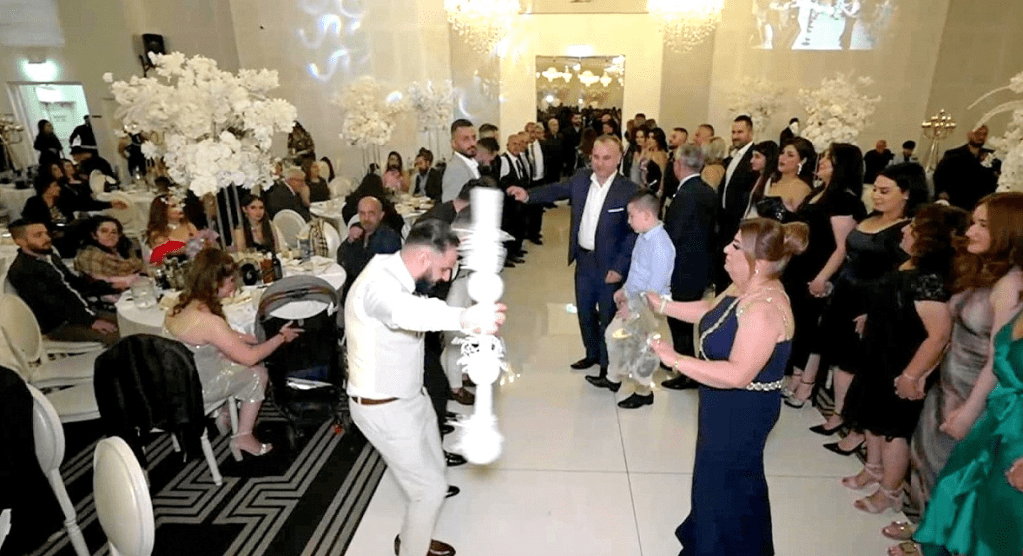
How to Khigga
There are MANY variations to this popular dance, but at it’s base is our ever-popular Taproot Dance. Indeed, Khigga may be the original Taproot dance.
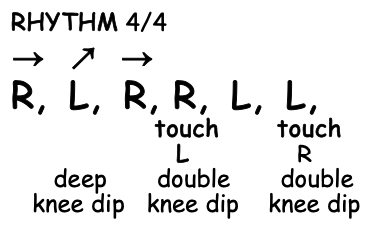

https://www.youtube.com/watch?v=6UdpfPi7FZw
Labeled Khigga but not Khigga
BEWARE! Often an Assyrian dance is labeled Khigga but is something else, likely Sheikhani (as is this dance). Khigga is sometimes used to refer to any Assyrian dance.
 Folkdance Footnotes
