
The Csángó are Hungarian-speaking Catholics occupying an area in Moldavia, deep in Romanian-speaking, Orthodox Romania. For more on the Csángó, click here. Long neglected, they were ‘rediscovered’ by Hungarians in urban Hungary in the 1990’s, where the Csángó’s simple, ancient dances became popular among younger folk dancers.
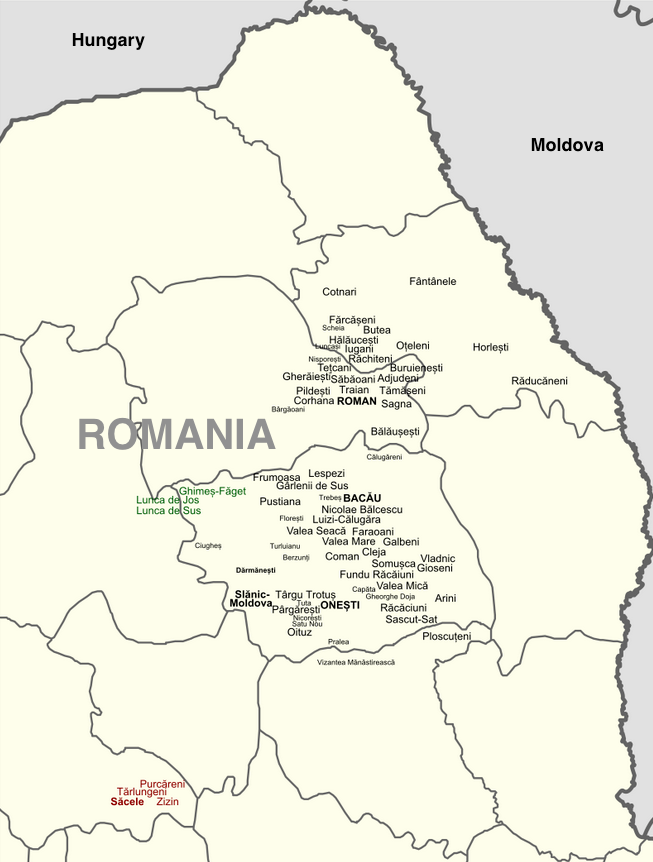
Black: Csángós of Western Moldavia, (Moldvai Csángó)
Green: Csángós around the Ghimeș-Palanca Pass, (Gyimesi Csángó)
Red: Csángós of the Seven Villages. The Csángós of Northern Dobruja are not shown in this map.
Comment: Anonymous wrote: With regard to the specific dance nyelu, you should refer to the Moldvai csángós, not those who live between Transylvania and the province of Moldavia (Gyimesi csangos) and who have their own reflex of this dance called zalunelu. Both names and the rough structure of the corresponding dances and melodies are derived from the ethnic Romanian song, melody, and dance called alunelul (Romanian for the little hazelnut). The moldvai csángó material did not hit the Budapest scene until about 1990, but the gyimesi material had been around for a few decades before that.
MUSIC
DANCE
COMMENTS:
Anonymous wrote: I taught this dance in St. Louis about 6 years ago, and it has been quite popular since. The Sürrentõ recording is excellent, but is about 7 minutes long and has to be cut down for most groups. ”Nyelu” is believed by many folklorists to be an alteration of the Romanian “Alunelu”, and, certainly, there are similarities.
 Folkdance Footnotes