
*a Living dance is a 1st Generation dance that is still performed in the country of origin (or immigrant communities) as part of a social event like a wedding where others can participate (not for an audience) by people who learned the dance informally (from friends and relatives by observation and imitation, not in a classroom situation). For more information, click here and here.
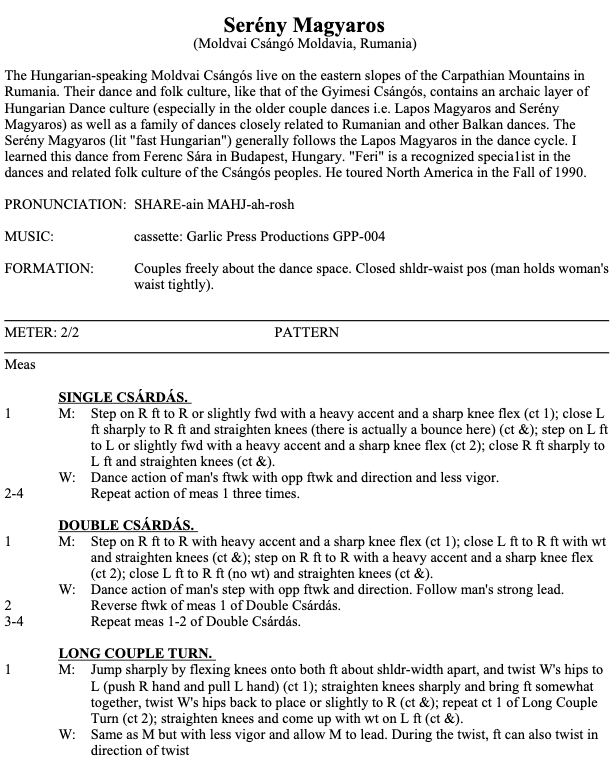
PRONUNCIATION: SHARE-ain MAHJ-ah-rosh
Serény Magyaros appears to be first and foremost a melody of the Csángó people.
NOTE:
There are several dances using this melody.
Circle Dance
This is a Living dance, accompanied by live music. Musicians adapt to the demands of the dancers. Dancers do not necessarily learn from the same source. Tempos vary, and in some cases a phrase may be repeated to lengthen a particular section. The direction and type of step in Melody 2 also varies. There are several YouTubes shown, which combined are the basis for this description.
Meter: fast4/4
Formation: Circle, In children’s version, hands down in “V”. In adult version, back basket hold.
Introduction: Two-measure fade-in. Start when new melody starts.
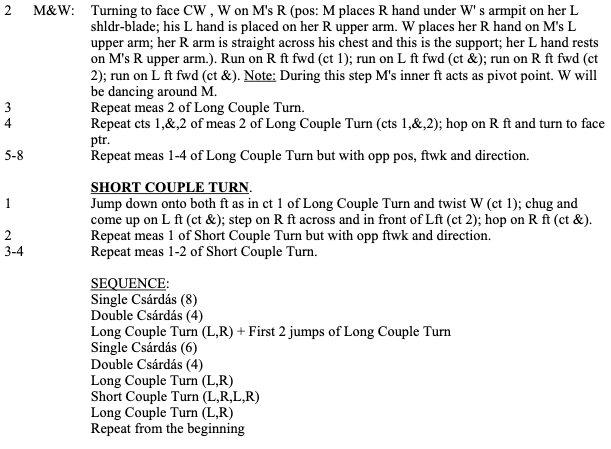
Melody 1 – Double csárdás step
Measure 1. Step to the Right with the Right foot; close the Left foot to the Right foot taking weight; step to the Right on the Right foot; close the Left foot to the Right foot (without weight).
In some versions dancers may kick or stamp lightly on the 4th, non-weighted beat.
Measure 2. Repeat to the left, using opposite feet (starting on left).
Measures 3 & 4. Repeat measures 1 & 2.
Repeat measures 1-4.
Melody 2 – Upbeat rida steps to Right. (One version starts with a downbeat rida to the left, another simply runs, ending by jumping on both feet.)
Measure 1. Step onto the ball of the Right foot to the Right; step on full Left foot across and in front of the Right foot. Repeat. (2 ridas in one measure.)
Repeat, 4 measures total. On final beat close with weight on both feet.
Measures 5-8. Repeat to left, still using upbeat ridas.
Note: some musicians double the length of Melody 2, allowing Measures 5-8 to continue in the same direction as measures 1-4, then dancers change direction for measures 9-16.
Couple Dances
The dances of the Hungarians living in Moldavia, the Csángós, are significantly different from those living in the Carpathian Basin. Couple dances are hardly found here, chain and circle dances are more typical, and the set of motifs of these dances is usually tied. Serene Hungarians are walked in small circles, holding their belts, and as the name suggests: at a fairly fast pace. The dancers hold on to the “bernic”, a woven textile belt worn as part of the costume. Both the dance and the accompanying music consist of two units: in the first, the dancers, who are usually four together in a small circle, walk the basic motif corresponding to the two-step dance, while they turn left and right to the second melodic part. In Klézsé and Somoska, the rotation is more pronounced, in other villages, for example, in Külső-Rekecsin, it is internal, and it is emphasized below. The members of the band accompanying the dance typically play the flute, kobzo, violin, and more recently the drum. The fast Hungarian melody can also be heard sung with lyrics in the guzsalyas.
Google translated from https://tudasbazis.sulinet.hu/hu/muveszetek/tanc-es-drama/a-magyar-neptanc-tipusai/2/magyar-vagy-negyes-tancok/moldvai-sereny-magyaros
 Folkdance Footnotes