
*S is for Song., ** 1 is for a 1st Generation dance
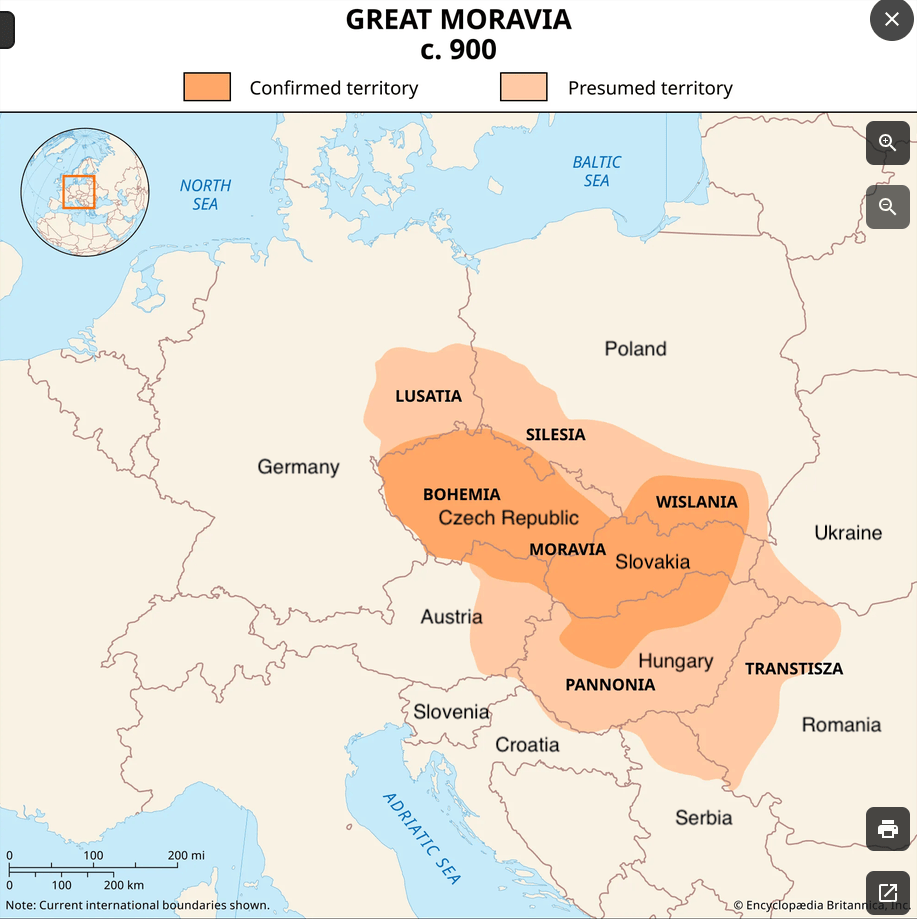
Moravia, home of Čerešničky
The home of this song in the Zlín Region in the southwest of Moravia, where four different ethnographic regions overlap: Wallachia, Moravia, Slovakia, and Haná.
Čerešničky, the Song
In Moravia, the part of the Czech republic this dance comes from, Čerešničky (pronounced CHAIR-esh-neech-kee) “little cherries”, is primarily known as a song sung by girls and young women. I’m speculating that the song was sung mostly during cherry harvest as a pleasant way of passing time while picking.
Above are but a few of the MANY examples and styles of Čerešničky YouTubes. A truly iconic Czech folk song!
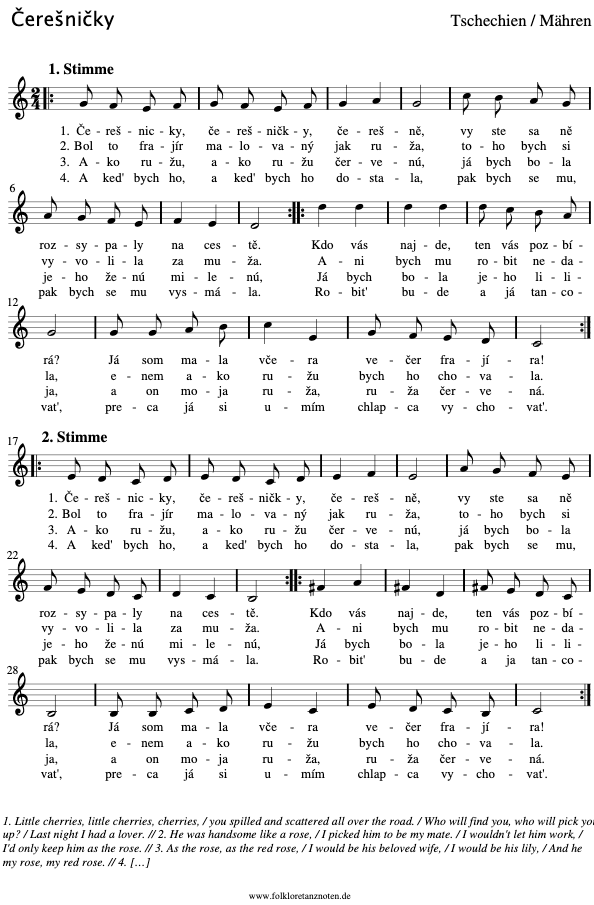
/ Čerešničky, čerešničky, čerešnĕ         Little cherries, little cherries, oh cherries,
  vy jste se mi rozspaly na cestĕ! /        you spilled and scattered all over the road!
/ Kdo vás najde, kdo vás posběrá?        Who will find you, who will pick you up?
  Ja som mala včera večer frajera! /      Last night I had a lover!

/ Bol to frajer maľolovaný jak růža,     He was handsome like a rose,
  toho som si vyvolila za muža. /          I picked him to be my mate.
/ Ani bych mu robiť nedala,                  I wouldn’t let him work,
  lenom ako růžu bych ho chovala. /   I'd only keep him as the rose.

/ Ako růžu, ako růžu, červenú,             As the rose, as the red rose,
  já bych bola jeho ženú milenú, /        I would be his beloved wife,
/ Já bych bola jeho Lália,                        I would be his Lalia,
  ako moja růža, růža červená. /            as my rose, my red rose.
Source: Fort Collins Folk Dance
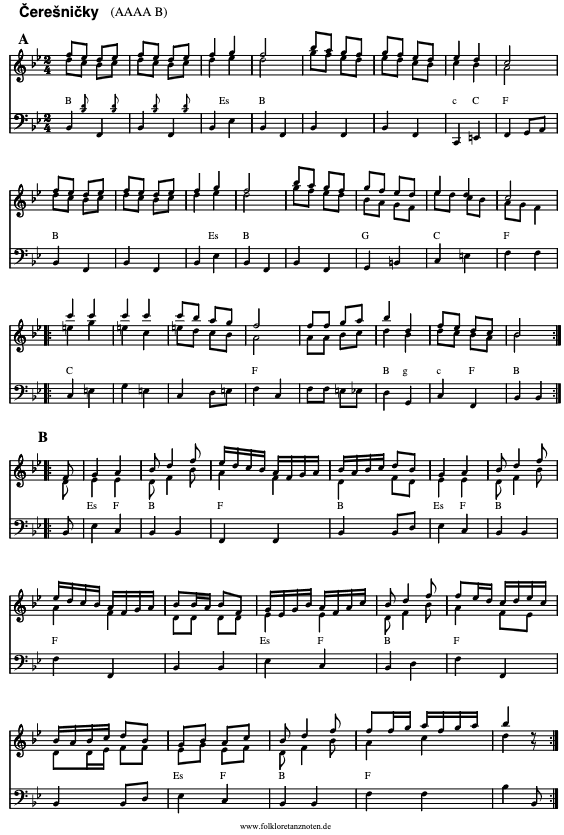
Čerešničky sheet music
Čerešničky, the Dance
I don’t have proof that the choreography North American folk dancers know as Čerešničky is (or was) a dance with a set format in the Czech Republic. When František Bonuš, taught the dance to North Americans in 1979, his notes indicated it was a “mixed circle dance with couple and small group variations.” I also have no proof the dance is “Living” today.
As currently danced in Europe
As danced in North America
The dance was introduced to North America in 1979 by František Bonuš, dance master of the Prague Conservatory.
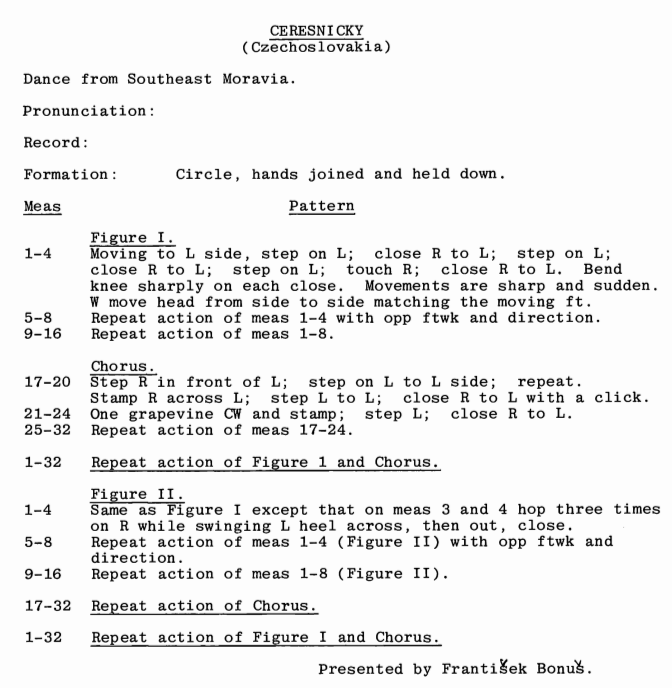
Notes below ©2014, Andrew Carnie. Originally taught by František Bonuš.
Music: there are numerous recordings of this available on iTunes, Amazon and Youtube
Meter: 2/4
Formation: Closed circle, hands down in V position. Originally a women’s dance it’s now done by both genders
Part 1: Extended Čardaš
Bar 1: Facing center, Step L to L, arms swing slightly forward (1), close R with weight next to L arms swing back to sides (2)
Bar 2: repeat bar 1
Bar 3: Step L to L, arms swing slightly forward (1), touch R toe to R (2)
Bar 4: Close R next to L with weight, arms swing back (1), pause (2)
Bars 5-8: repeat bars 1-4
Bars 9-16: repeat bars 1-8, on the last beat do not take weight on R
(Note: there are some groups that do this dance with the opposite footwork and direction, e.g., they start by doing the Čardaš to the right first. The original notes (see linked notes below) also have a variation of this step where there bars 3 and 4 have two lifts of the free foot followed by a close. I’ve never seen any North American group do this variation)
Bar 3 Variations (Odd # times through, choose one)
* These start with the same foot (per direction, i.e. L travel = L foot) as bars 1&2
Boring Touch: Step (L to side), Touch (R) in place, Close
Better Touch: Step (L to side), Touch (R) to side, Close

Bar 3 Variations (Even # times through, choose one)
* These start with the opposite foot (per direction) as bars 1&2
Lift Across: (for L travel) Lift(R up & down) while Heel(L) across(R), Lift + Heel to side, Close
Hopscotch: (for L travel) Hop up w/ both and cross L over R, Jump both wide apart, Jump both closed

Bar 3 Variations source: Fort Collins Folk Dance
Part 2: Rida and Grapevine
Bar 1: Cross R over L (1), step L to L (2)
Bar 2: Repeat bar 1
Bar 3: Repeat bar 1 (turning to face center)
Bar 4: Click R next to L with no weight (1), pause (2)
Bar 5: Cross R over L (1) step L to L (2)
Bar 6: Step R behind L (1) step L to L (2)
Bar 7: Repeat bar 3
Bar 8: Repeat bar 4
Bars 9-16: repeat bars 1-8
Alternate the two steps to the end of the music.
The original notes include an [fast] ending step (see the links below) for use with a particular recording.

